
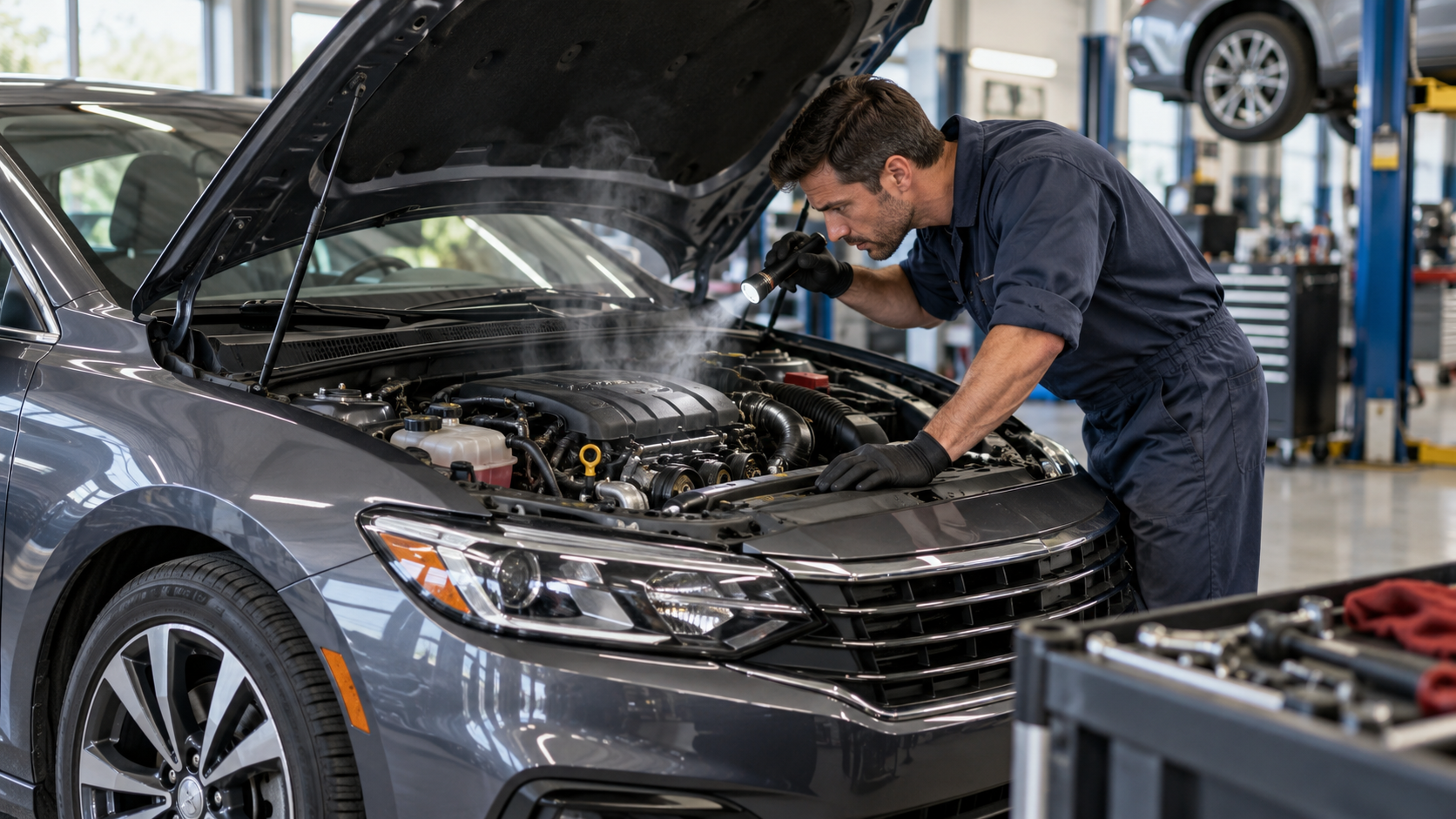
You are driving normally, pull into a parking lot, and suddenly notice it: a sharp, hot smell that reminds you of burnt tires, melted rubber, or something overheating under the hood.
It is the kind of smell that gets your attention fast. And it should.
If you are asking, “why does my car smell like burning rubber,” there is no single answer. The odor can come from something fairly simple, such as a plastic object touching a hot exhaust component. But it can also point to a slipping drive belt, overheated brakes, a clutch problem, a fluid leak, a tire rubbing against the body, or another part getting hotter than it should.
The smell itself is only the first clue. When it happens, where it comes from, and what the car was doing just before you noticed it can narrow things down considerably.
One important point first: if you see smoke, flames, a rapidly rising temperature gauge, warning lights, loss of steering assistance, sudden braking problems, or a strong electrical-burning smell, pull over somewhere safe and shut the vehicle off. Do not keep driving just because the car still moves.
Now, assuming there is no immediate emergency, here is how to make sense of that burnt-rubber odor.
What Does a Burning Rubber Smell in a Car Usually Mean?
A true burning-rubber smell usually means heat is affecting rubber, friction material, a belt, a hose, a tire, or another synthetic component.
But smells inside a car are surprisingly easy to confuse.
Hot brakes can smell sharp and chemical. Burning oil can have an acrid odor. Electrical insulation can smell like hot plastic. A slipping clutch can smell somewhat like burnt paper, rubber, or hot friction material.
So the question is not only “what smells like rubber?” It is also “what got hot enough to create this smell?”
That is usually where the diagnosis starts.
Common Reasons Your Car Smells Like Burning Rubber
| Possible Cause | When You May Notice It | Other Clues |
|---|---|---|
| Slipping serpentine or accessory belt | After starting, accelerating, or turning on accessories | Squealing, chirping, charging or cooling problems |
| Overheated brakes | After hard braking, mountain driving, or stop-and-go traffic | Hot wheel, pulling, brake smell, reduced braking performance |
| Dragging brake caliper | During ordinary driving | One wheel much hotter than others, pulling, poor fuel economy |
| Clutch overheating | After hill starts, heavy traffic, towing, or riding the clutch | Engine revs rise without matching acceleration |
| Tire rubbing | During turns, bumps, or after suspension/wheel changes | Rub marks, damaged sidewall, scraping noise |
| Rubber hose touching a hot part | After the engine warms up | Localized odor under hood, damaged or softened hose |
| Fluid leaking onto hot components | After driving or when parked after a trip | Smoke, drips, oily residue, fluid level changes |
| Plastic debris on exhaust | Often after driving over road debris | Smell mainly from underneath vehicle |
| Failing pulley or bearing | While engine is running | Grinding, squealing, belt heat, wobbling pulley |
| Electrical overheating | Any time a circuit or component is overloaded | Hot-plastic smell, flickering electronics, blown fuse |
A Slipping Serpentine Belt Is a Common Suspect
The serpentine belt runs several accessories on many modern engines. Depending on the vehicle, that can include the alternator, air-conditioning compressor, power-steering pump, or water pump.
If the belt slips instead of moving cleanly across its pulleys, friction creates heat.
That heat can produce a very recognizable burning-rubber smell.
You might also hear a squeal, chirp, or screech from the front of the engine. The noise may appear when you start the car, switch on the air conditioner, turn the steering wheel on vehicles with belt-driven hydraulic power steering, or accelerate.
A worn belt is one possible cause, but the belt itself is not always the real problem.
A seized or failing pulley, weak tensioner, misaligned accessory, or failing compressor can force the belt to slip.
That matters because replacing a belt without fixing the seized component may simply destroy the new belt too.
If the belt is visibly frayed, shiny, cracked, partially melted, or walking off a pulley, avoid unnecessary driving until the cause is inspected.
Could It Be the Brakes?
Absolutely.
Brake friction creates heat every time you slow the vehicle. During normal driving, the system is designed to handle it. But repeated hard braking, long downhill grades, towing, or a mechanical problem can raise temperatures dramatically.
Hot brakes may create a strong odor that people often describe as burning rubber, burnt carpet, hot chemicals, or scorched material.
If the smell appears after descending a steep mountain road, the brakes are an obvious area to consider.
But if it happens during normal suburban driving, a dragging brake deserves more attention.
A Dragging Brake Can Stay Hot Even When You Are Not Braking
A brake caliper can stick and keep a brake pad pressed against the rotor even after you release the pedal.
The vehicle may still drive. That is what makes the problem easy to miss at first.
You may notice:
- The vehicle pulls slightly to one side.
- One wheel smells much hotter than the others.
- A wheel produces unusual heat after a short drive.
- Fuel economy drops.
- The car feels slightly resistant when coasting.
- Brake dust builds up heavily on one wheel.
- The burning smell returns repeatedly during ordinary driving.
Do not touch a wheel, rotor, or brake assembly immediately after driving to “see if it is hot.” Brake components can become hot enough to cause burns.
If you suspect a dragging brake, continuing to drive can overheat pads, rotors, wheel bearings, brake fluid, and nearby components. Have it checked promptly.
Manual Transmission? The Clutch May Be Overheating
Drivers of manual-transmission cars have another possible source.
A clutch works through controlled friction. When it slips too much, it gets hot.
This commonly happens during repeated hill starts, aggressive launches, very slow crawling traffic, towing, or keeping your foot partly on the clutch pedal while driving.
The smell can be strong enough to enter the cabin.
One brief episode does not automatically mean the clutch is ruined. For example, an awkward hill start can overheat the friction material temporarily.
But a smell that appears regularly during normal acceleration is different.
A worn clutch may slip under load. You press the accelerator, engine rpm climbs, but vehicle speed does not rise at the same rate.
That is a sign to have the clutch inspected rather than simply ignoring the smell.
Could a Tire Be Rubbing Against the Car?
Yes, particularly if the vehicle has recently had wheels, tires, suspension parts, or ride-height modifications installed.
A tire can contact the inner fender liner, suspension component, mud flap, or wheel-well material.
The problem may only appear during sharp turns or when the suspension compresses over a bump.
You may hear scraping along with the smell.
Look for fresh shiny areas, black rubber marks, worn plastic, or damage to the tire’s sidewall or shoulder.
A tire that is physically rubbing is not something to ignore. Repeated contact can damage the tire, and sidewall damage can become a safety issue.
Check for Something Touching the Exhaust
This one is almost annoyingly simple.
You drive over a plastic bag or other lightweight road debris. It gets caught underneath the car and lands against the exhaust.
The exhaust gets hot. The plastic melts.
Then your car smells terrible for the next several drives.
A melted plastic bag can create an odor that is very easy to mistake for rubber.
If the vehicle is otherwise driving normally and the smell seems strongest underneath rather than inside the engine compartment, road debris is worth checking.
Do not crawl under a vehicle supported only by a jack, and do not touch exhaust components shortly after driving. They can remain extremely hot.
Rubber Hoses Can Touch Hot Engine Parts
Under the hood, several hoses carry coolant, air, vacuum, fuel vapor, and other fluids or gases.
These parts are routed carefully because the engine and exhaust system generate serious heat.
If a hose becomes loose, a mounting clip breaks, or earlier repair work leaves something routed incorrectly, rubber can end up resting against a hot metal surface.
The smell may begin only after the engine reaches operating temperature.
You might notice a softened, glossy, scorched, or deformed section of hose.
This deserves quick attention because a damaged hose may eventually leak.
Oil or Fluid Leaks Can Smell Like Rubber Too
Not every “burning rubber” smell is actually rubber.
Engine oil dripping onto an exhaust manifold or another hot exhaust part produces a sharp burning smell and sometimes visible smoke.
Other automotive fluids can also create unusual odors when they contact hot components.
Look for fresh wet areas around the engine bay, spots beneath the vehicle, or smoke rising from one specific area after parking.
Do not reach around a hot engine trying to identify the leak by touch.
And if the vehicle is losing oil, coolant, brake fluid, or another essential fluid, the leak matters even if the smell itself seems mild.
When a Pulley or Bearing Starts to Seize
The belt system depends on several components spinning freely.
Idler pulleys, tensioners, alternators, compressors, and other accessories contain bearings.
When a bearing starts failing, the component may resist rotation.
The belt continues trying to move across it.
Friction rises. Heat rises. Then you may get belt squeal, a burning-rubber odor, or both.
Sometimes a failing pulley also wobbles visibly while the engine is running.
Do not put your hands, clothing, hair, or tools near moving belts and pulleys with the engine running.
The Air-Conditioning System Can Be Involved
If the smell appears mainly after you switch on the A/C, pay attention to that pattern.
The air-conditioning compressor adds load to the accessory belt system. A failing compressor, clutch, pulley, or belt tensioner may begin slipping when that extra load appears.
In some cars, an electrical problem with the blower motor, resistor, wiring, or another HVAC component can create a hot-plastic or electrical smell that gets mistaken for rubber.
If the odor comes directly through the vents, turn the climate system off and see whether the smell changes.
That does not diagnose the problem by itself, but it gives a technician a useful clue.
Burning Rubber Smell After an Oil Change
This can happen even when nothing major is wrong.
A small amount of oil may spill onto a hot engine or exhaust surface during service. When the engine warms, that residue can burn off and create an unpleasant smell.
The odor should gradually disappear.
But there is a difference between leftover residue and an active leak.
If the smell continues for several drives, becomes stronger, produces ongoing smoke, or you notice the oil level dropping, have the vehicle checked.
A loose oil cap, improperly installed filter, drain-plug problem, or spilled oil in the wrong location may need attention.
Burning Rubber Smell After Getting New Tires
New tires have a noticeable rubber odor, especially when warm.
That alone is not necessarily a problem.
But a true burning smell after new tires were installed deserves a quick visual check.
Confirm that the tire is not contacting the wheel well, suspension, or body. This is particularly important if the new tires are a different size from the originals.
Also check whether a wheel-well liner or splash shield was disturbed during service.
Burning Smell After Driving Through Snow
Winter creates some odd situations.
Snow and ice can pack into wheel wells. Plastic liners can shift. A chunk of frozen debris can push against something it normally would not touch.
If the tire begins rubbing, you may smell hot rubber or plastic.
Snow can also accumulate around brakes and then melt during driving.
If the odor is accompanied by scraping, pulling, vibration, or a visibly damaged tire, stop and inspect the vehicle rather than assuming the snow will simply disappear.
Burning Rubber Smell After Hard Acceleration
If the smell appears only after aggressive acceleration, think about components that are under greater load during that moment.
On a manual car, the clutch is one possibility.
On many vehicles, the accessory belt is another.
Wheelspin can obviously create a tire smell as well.
And on performance vehicles, hard driving can heat brakes, tires, exhaust components, and the drivetrain enough that several odors mix together.
A one-time smell after extremely hard driving is different from a smell appearing during ordinary acceleration. The second scenario deserves more attention.
What if the Smell Comes From One Wheel?
This is a useful clue.
If one wheel smells significantly hotter than the others, possible causes include a dragging brake, parking-brake problem, bearing issue, tire rubbing, or something caught near the wheel.
Do not pour water onto a hot brake rotor to cool it quickly. Rapid temperature change can damage components.
If the brake is severely overheated, the safest move is usually to stop driving and have the vehicle inspected.
What if the Smell Comes Through the Vents?
The source may still be under the hood.
The HVAC system draws outside air from an intake near the base of the windshield on many vehicles. An odor from the engine compartment can therefore enter the cabin.
If switching from fresh-air mode to recirculation reduces the smell, that can suggest the source is outside the passenger compartment.
But electrical HVAC components can create their own smell too.
A burning smell from the vents combined with a failing blower, flickering electronics, smoke, or blown fuses deserves immediate attention.
Burning Rubber vs Burning Oil vs Electrical Smell
| Smell | Typical Description | Possible Sources |
|---|---|---|
| Burning rubber | Hot tire, scorched rubber, sharp synthetic odor | Belt, hose, tire rubbing, clutch |
| Burning oil | Heavy, acrid, smoky odor | Oil leaking onto hot engine or exhaust |
| Hot brakes | Sharp chemical or scorched friction smell | Hard braking, dragging caliper, parking brake |
| Electrical burning | Hot plastic, insulation, sometimes fishy or chemical | Wiring, connectors, blower motor, electrical module |
| Melting plastic | Sweetish synthetic or harsh plastic odor | Road debris on exhaust, trim touching hot parts |
| Clutch | Burnt friction material, sometimes similar to rubber | Slipping or overheated manual clutch |
Smell descriptions are subjective, so treat this table as a clue rather than a diagnosis.
Can an Electrical Problem Smell Like Burning Rubber?
Yes.
Wire insulation, connectors, plastic housings, and electrical components can overheat and create a smell that people describe as burning rubber.
This can happen because of excessive current, damaged wiring, a short circuit, poor electrical connection, or a failing component.
Electrical overheating deserves caution because it can progress quickly.
If you smell strong hot plastic or electrical burning, especially with smoke, flickering lights, malfunctioning electronics, or repeated blown fuses, shut the vehicle off when safe and have it inspected.
When Should You Stop Driving?
You do not need a tow truck every time a faint odor appears for a few seconds. But some combinations of symptoms change the situation quickly.
- Stop if you see smoke coming from the engine bay, wheel area, or underneath the vehicle.
- Stop if the temperature gauge moves into the hot range.
- Stop if braking performance changes or the vehicle pulls strongly while braking.
- Stop if a tire is visibly damaged or rubbing badly.
- Stop if the steering suddenly becomes unusually heavy.
- Stop if the battery or charging warning appears together with belt noise.
- Stop if you hear loud belt squealing and see belt damage.
- Stop if you smell strong electrical burning or see melted wiring.
- Stop if flames are visible and move away from the vehicle.
If there is an actual vehicle fire, get everyone out, move a safe distance away, and call emergency services. Do not open the hood fully if there are flames underneath it, because additional oxygen can intensify the fire.
What Can You Safely Check Yourself?
Once the vehicle has cooled and is parked safely, there are a few basic observations you can make without dismantling anything.
Look around the tires for obvious rubbing or sidewall damage.
Look underneath for melted road debris.
Check the serpentine belt visually if it is easily accessible and the engine is completely off. Look for fraying, cracks, missing ribs, melted areas, or a belt that appears out of place.
Check underneath the car for fresh fluid spots.
Look for smoke residue or a hose touching a hot metal component.
And pay attention to where the smell is strongest.
Front of engine? One wheel? Under the center of the car? Through the vents?
Those details are often more useful to a mechanic than saying only, “something smells burnt.”
What You Should Not Do
Do not reach near moving belts with the engine running.
Do not touch brake rotors or exhaust parts right after driving.
Do not crawl underneath a vehicle supported only by its emergency jack.
And do not keep driving a vehicle that is clearly overheating because you are “almost home.”
That last mile can turn a manageable repair into a much bigger one.
Can the Smell Go Away on Its Own?
Sometimes.
A plastic bag stuck to the exhaust may eventually burn away. A small amount of spilled oil after service may stop smelling once the residue is gone. A clutch that was overheated during one awkward hill start may cool and return to normal.
But recurring smells are different.
If the smell disappears and then returns every time you use the A/C, brake hard, drive ten miles, or accelerate uphill, the pattern matters.
Something is repeatedly creating heat.
That should be investigated.
How Much Can a Repair Cost?
The range is huge because “burning rubber smell” is a symptom, not a repair.
A piece of plastic stuck to the exhaust might cost nothing to remove.
A simple belt replacement may be relatively modest.
A seized A/C compressor, damaged braking system, clutch replacement, electrical repair, or major fluid leak can be far more expensive.
This is another reason diagnosis matters before buying parts.
Replacing the belt because it smells burnt does not help much if the real cause is a seized pulley that immediately overheats the replacement.
How a Technician Usually Tracks the Smell Down
A good diagnosis starts with the story.
When did you smell it?
Was the A/C running?
Were you braking downhill?
Did the smell begin after recent repairs?
Does it happen only during acceleration?
Does one wheel smell stronger?
From there, a technician may inspect the belt drive, brake temperatures, fluid leaks, tire clearance, clutch operation, electrical components, and exhaust area.
The more specific you can be, the less time gets wasted chasing the wrong system.
FAQ
Why does my car smell like burning rubber but there is no smoke?
A belt may be slipping, brakes may be overheating, a clutch may be getting hot, or rubber or plastic may be touching a hot surface without producing visible smoke. Lack of smoke does not automatically mean the problem is harmless.
Can low oil cause a burning rubber smell?
Low oil itself does not typically smell like burning rubber. However, an oil leak can drip onto hot engine or exhaust components and create a strong burning odor that may be mistaken for rubber. Check the oil level and look for signs of leakage.
Why does my car smell like burning rubber when I accelerate?
Possible causes include a slipping accessory belt, overheated clutch on a manual vehicle, tire spin, or a component that moves or shifts under engine load and contacts something hot.
Why does my car smell like burning rubber after driving?
Heat builds during driving, so problems such as dragging brakes, fluid leaks onto the exhaust, tire rubbing, a slipping belt, or plastic debris on the exhaust may become more noticeable after several miles.
Can bad brakes smell like burning rubber?
Yes. Overheated brake pads and rotors produce a strong burnt smell that many drivers describe as rubber-like or chemical. If one brake is dragging, the smell may appear even without hard braking.
Is it safe to drive with a burning rubber smell?
It depends on the cause, but you should not ignore it. If there is smoke, overheating, brake trouble, damaged tires, loud belt noise, electrical symptoms, or a strong worsening smell, stop driving and have the car inspected.
Why does the burning smell appear when I turn on the air conditioner?
The A/C system adds load to the engine’s accessory drive. A weak belt, failing tensioner, compressor problem, or pulley issue may begin slipping under that load. Electrical HVAC components can also create hot-plastic odors.
Conclusion
If you are wondering, “why does my car smell like burning rubber,” the smell is telling you that something somewhere is getting hot enough to matter.
Sometimes the explanation is simple. A plastic bag may have landed on the exhaust. A little oil may have spilled during service. A clutch may have been overheated once during a difficult hill start.
But recurring odors deserve more attention.
A slipping belt can eventually fail. A dragging brake can overheat. A rubbing tire can become damaged. A leaking fluid can reach a hot exhaust surface. An electrical component can overheat behind trim where you cannot see it.
The useful clues are usually the timing and location.
If the smell starts with the A/C, think about the belt drive and HVAC system.
If it starts after braking, look toward the brakes.
If it comes from one wheel, that narrows the field considerably.
If it happens after an oil change, spilled oil or an active leak deserves a look.
If the smell comes with squealing, warning lights, smoke, abnormal steering, braking changes, or rising engine temperature, do not treat it as a minor annoyance.
And remember that “burning rubber” is only a description. The real source may be rubber, friction material, oil, plastic, or electrical insulation.
You do not have to diagnose every part yourself.
What helps is noticing the pattern, checking the obvious areas safely, and describing the symptoms clearly when the car is inspected.
A strange smell is easy to dismiss when the car still runs normally.
But cars rarely create burning odors for no reason.
If the smell keeps coming back, something is asking for attention.
Leave a Reply