
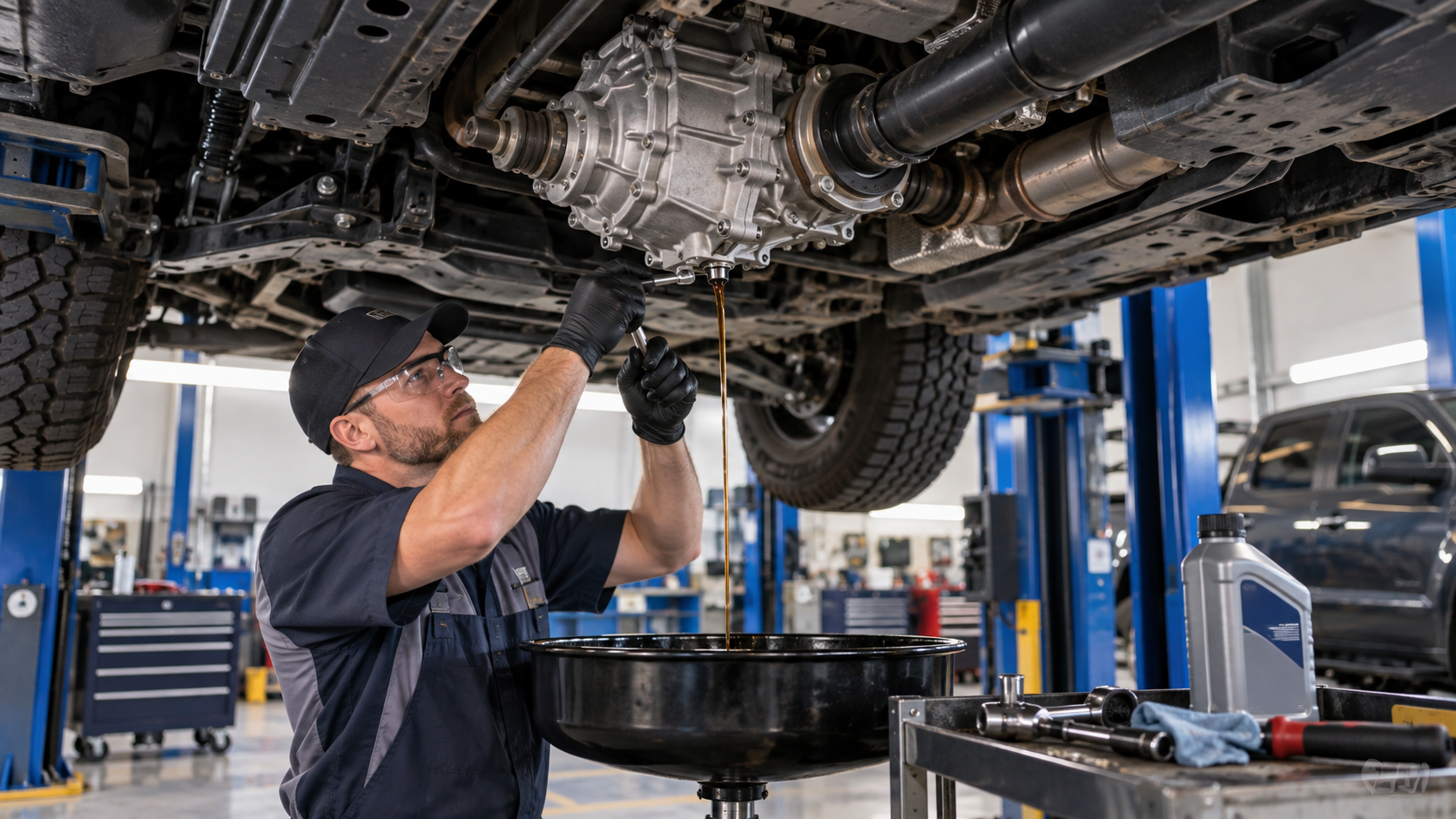
If you drive a 4WD truck or SUV, or certain AWD vehicles, there is a part of the drivetrain that rarely gets much attention until something starts making noise: the transfer case.
Most drivers remember engine oil. Tires get checked. Brake pads eventually make themselves impossible to ignore. But transfer case fluid? That can sit quietly in the background for years.
And that’s exactly why it’s easy to forget.
A transfer case fluid change is basic preventive maintenance on vehicles equipped with a serviceable transfer case. The fluid lubricates gears, bearings, chains, clutches, and other internal parts depending on the design. Over time, that fluid can degrade, become contaminated, or collect tiny particles from normal wear.
The tricky part is that there is no single service interval that works for every vehicle in the USA. Some manufacturers specify relatively frequent servicing under severe driving conditions. Others allow much longer intervals. Some transfer cases use automatic transmission fluid, others require gear oil or a manufacturer-specific transfer case fluid.
So no, this isn’t one of those jobs where you grab a random bottle from the auto-parts shelf and call it a day.
Here’s how the system works, why the fluid matters, and how to tell when yours may be due for service.
What Is a Transfer Case?
A transfer case is part of the drivetrain on many four-wheel-drive vehicles and some all-wheel-drive systems.
Its basic job is to distribute engine power between the front and rear axles.
On a traditional 4WD truck, the transmission sends power into the transfer case. The transfer case then routes that power to the rear driveshaft, front driveshaft, or both, depending on the selected drive mode.
Some systems also include low-range gearing for slower driving with more torque, useful for off-road situations, steep terrain, deep snow, or other low-speed conditions.
Modern AWD designs can be quite different. Some use electronically controlled clutch packs to vary torque distribution automatically. Others use a power transfer unit or another type of coupling rather than the classic truck-style transfer case.
That difference matters when you’re looking up maintenance.
If your owner’s manual talks about a transfer case, power transfer unit, PTU, center differential, or AWD coupling, don’t assume the service procedure or fluid is identical between them.
What Does Transfer Case Fluid Actually Do?
Inside a transfer case, parts move under substantial load. Gears mesh. Bearings spin. Chains may rotate. Clutch packs may engage and disengage.
The fluid creates a lubricating film between those moving surfaces.
It also helps manage heat and carries microscopic wear particles away from critical contact areas until they settle or are captured by a magnetic drain plug, if the case has one.
In some electronically controlled transfer cases, the fluid also has to work correctly with wet clutch materials. That makes the exact fluid specification especially important.
The basic functions include:
- Lubricating gears, bearings, chains, and shafts.
- Reducing friction between moving components.
- Helping control operating temperatures.
- Protecting metal surfaces against wear.
- Supporting proper clutch operation in transfer cases that contain clutch packs.
- Carrying normal wear particles away from contact surfaces.
Fresh fluid cannot prevent every mechanical failure, of course. But running the correct fluid at the correct level gives those components the environment they were designed to operate in.
Why Does Transfer Case Fluid Need to Be Changed?
Lubricant doesn’t stay new forever.
Heat cycles gradually change its properties. Additives can become depleted. Moisture may enter through normal venting. Small amounts of metal from normal wear can accumulate.
If a transfer case has clutches, the fluid may also collect friction-material debris.
Heavy towing, off-road driving, frequent four-wheel-drive use, deep-water crossings, high temperatures, and repeated operation under heavy load can be harder on the fluid than relaxed highway driving.
This is why some manufacturers distinguish between normal and severe service.
Someone commuting 20 miles on smooth interstate pavement in a lightly loaded SUV does not put the drivetrain through the same conditions as someone towing a camper through the Rocky Mountains or regularly driving a pickup off-road.
How Often Should You Change Transfer Case Fluid?
There is no universal mileage number.
You will see plenty of generic advice online suggesting fixed intervals such as 30,000, 50,000, or 60,000 miles. Those numbers may fit some vehicles, but they should not replace the maintenance schedule for your exact year, make, model, drivetrain, and operating conditions.
The owner’s manual or manufacturer’s maintenance information should be the starting point.
Some vehicles call for transfer case service at a defined mileage. Others mention inspection first and replacement under specific operating conditions. Certain modern systems may use different service strategies entirely.
| Driving Situation | Why It Matters | What to Do |
|---|---|---|
| Normal commuting | Usually places moderate load on the drivetrain | Follow the normal maintenance schedule |
| Frequent towing | Increases drivetrain load and heat | Check severe-service recommendations |
| Regular off-road driving | Can mean more heat, shock loads, dirt, and water exposure | Inspect and service more carefully |
| Deep-water crossings | Water contamination is possible if seals or vents are compromised | Inspect fluid after exposure if recommended |
| Frequent 4WD use | Transfer case components spend more time actively carrying load | Follow manufacturer guidance for heavy use |
| Unknown service history | You may not know the fluid’s age or condition | Have the system inspected and identify the correct service |
If you bought a used truck with 90,000 miles and no maintenance records, it makes sense to find out whether the transfer case has ever been serviced rather than guessing.
Signs Your Transfer Case Fluid May Need Attention
Old fluid does not always produce obvious symptoms.
In fact, preventive maintenance works best when you replace the fluid before the vehicle complains.
Still, certain symptoms can point toward a transfer case problem. They do not automatically mean the fluid itself is the cause, but they deserve investigation.
- Grinding, whining, or unusual humming from the drivetrain.
- Difficulty shifting between 2WD, 4HI, and 4LO on vehicles with selectable modes.
- Binding, shuddering, or jerking during turns.
- A 4WD or AWD warning message on the dashboard.
- Fluid leaking from the transfer case area.
- Burning or unusually strong fluid odor.
- New vibration that changes with vehicle speed.
- Repeated failure of the four-wheel-drive system to engage properly.
But here’s the important part: these symptoms can also indicate worn bearings, damaged gears, stretched chains, faulty actuators, worn clutch packs, driveshaft problems, electrical faults, mismatched tires, or several other issues.
A fluid change is maintenance. It is not a magic repair for a mechanically damaged transfer case.
What Does Bad Transfer Case Fluid Look Like?
That depends heavily on the type of fluid originally installed.
Some transfer cases use red automatic transmission fluid. Others use amber or darker gear oil. Manufacturer-specific fluids may have their own appearance.
So color by itself is not enough to decide whether the fluid is good or bad.
A technician may look for contamination, metallic debris, burnt odor, water, abnormal discoloration, or a fluid level that is lower than specified.
Some fine metallic paste on a magnetic drain plug can occur as components wear normally. Large metal pieces, obvious glitter throughout the fluid, or chunks of material are another story.
That is usually a reason to investigate the transfer case rather than simply refill it and hope for the best.
Transfer Case Fluid Change vs. Transfer Case Flush
People often use these phrases interchangeably, but they are not always describing the same thing.
A conventional transfer case fluid change usually means draining the old lubricant and refilling the case with the correct new fluid.
Many transfer cases have dedicated fill and drain plugs, making the job fairly straightforward.
A machine-powered “flush” is not automatically required and may not even be an approved procedure for a given design.
If a shop recommends a special flushing process, ask whether that procedure is specified or approved for your exact transfer case.
For many vehicles, a normal drain-and-refill is the service described by the manufacturer.
What Fluid Goes in a Transfer Case?
This is where guessing becomes expensive.
Transfer cases do not all use the same lubricant.
Depending on the vehicle, the correct fluid may be a particular automatic transmission fluid, gear lubricant, or manufacturer-specific transfer case product.
Even two trucks from the same brand can require different fluids if they use different transfer case designs.
| Fluid Type | Where It May Be Used | Important Note |
|---|---|---|
| Automatic transmission fluid | Some traditional transfer cases | The required ATF specification must match the vehicle |
| Gear oil | Certain gear-driven transfer cases and related drivetrain units | Viscosity and performance specification matter |
| Manufacturer-specific transfer case fluid | Many modern electronically controlled systems | Substituting generic fluid may affect clutch operation |
| Special AWD/PTU lubricant | Some AWD power transfer units | This may not be the same service as a conventional transfer case |
The owner’s manual is useful, but some manuals direct owners to a dealer or technical fluid specification rather than naming a bottle on the page.
When in doubt, verify the fluid by VIN, vehicle documentation, or manufacturer parts information.
Can You Change Transfer Case Fluid Yourself?
On some vehicles, yes.
A conventional transfer case with accessible drain and fill plugs can be one of the more approachable drivetrain services for an experienced DIY owner.
But easy access does not mean there is no room for mistakes.
First, the vehicle needs to be safely supported and reasonably level when required by the service procedure. Never work underneath a vehicle held up only by an emergency jack.
Second, make sure you can remove the fill plug before draining anything.
That sounds almost silly, but it is a classic mistake.
You drain the case. Then the seized fill plug refuses to move. Now you own a vehicle that cannot be driven until you find another way to fill it.
Third, use the exact fluid specification and fill according to the manufacturer procedure. Some cases are filled until fluid reaches a specified opening. Others may require a particular quantity or procedure.
And do not overtighten plugs. Transfer case housings can be aluminum, and damaged threads turn a routine maintenance job into a much less entertaining afternoon.
Basic Steps in a Transfer Case Fluid Change
The exact process varies, so service information for the specific vehicle always wins. In broad terms, though, a conventional service often looks like this:
- Confirm the correct fluid and required quantity.
- Safely raise and support the vehicle if necessary.
- Locate the transfer case, fill plug, and drain plug.
- Remove or loosen the fill plug first.
- Place a suitable drain pan underneath the case.
- Remove the drain plug and allow the old fluid to drain.
- Inspect the fluid and magnetic plug, if equipped, for unusual debris.
- Install the drain plug using the specified procedure and torque.
- Add the correct new fluid through the fill opening.
- Set the final level according to the manufacturer procedure.
- Reinstall the fill plug and check for leaks.
That description is intentionally general. Plug locations, fluid levels, sealing washers, torque specifications, and temperature requirements can vary.
How Much Does a Transfer Case Fluid Change Cost?
Prices vary across the United States because labor rates, fluid costs, vehicle design, and regional pricing are different.
A simple truck transfer case that uses a modest amount of common fluid may be relatively inexpensive to service.
A luxury AWD vehicle using a specialized lubricant and a more involved procedure can cost more.
The bill can also rise if the shop discovers leaking seals, damaged plugs, contaminated fluid, or other drivetrain problems.
When comparing quotes, ask what is included.
You want to know whether the price covers the correct fluid, drain-and-fill service, seals or washers when required, inspection for leaks, and proper fluid-level setting.
Can You Drive With Low Transfer Case Fluid?
It is not something to ignore.
Low fluid means internal components may receive less lubrication and cooling than intended.
In a severe case, continued driving can damage bearings, gears, chains, or clutch components.
If the fluid is low because of a leak, topping it off without finding the leak only buys time.
A wet transfer case housing does not always mean a dramatic failure. Some leaks begin as a light seep around a seal or plug. But if the case keeps losing fluid, it needs attention.
Where Does Transfer Case Fluid Leak From?
Common leak locations can include drain or fill plugs, case seams, input seals, output shaft seals, and other sealing surfaces.
You may notice oily residue around the transfer case or spots beneath the center portion of the vehicle.
Fluid can also blow rearward while driving, so the wettest location underneath the vehicle is not always the actual starting point of the leak.
Cleaning the area and inspecting it again after driving can make the source easier to identify.
What Happens If You Never Change the Fluid?
Nothing dramatic may happen immediately.
That is why this service gets ignored.
The truck can still start. The 4WD button still works. No warning light appears. So another year passes.
Meanwhile, lubricant continues through thousands of heat cycles while wear material gradually accumulates.
Eventually, degraded or contaminated fluid can contribute to accelerated internal wear.
That does not mean skipping one interval instantly destroys a transfer case. Mechanical systems are not that predictable.
But replacing a few quarts of fluid is usually far simpler than dealing with internal drivetrain damage.
Transfer Case Fluid Change After Driving Through Water
Off-road drivers should pay special attention here.
A transfer case has vents that allow pressure changes as the unit heats and cools. If the case is submerged, water contamination may become a concern, especially if seals or vent components are damaged.
Water mixed with lubricant can reduce its protective qualities and promote corrosion.
After significant water exposure, check the manufacturer’s guidance and inspect drivetrain fluids when appropriate.
Fluid that appears milky or unusually cloudy can indicate water contamination.
Does Towing Affect Transfer Case Fluid?
Towing adds weight and drivetrain load.
Heat is the enemy of many automotive fluids, and higher sustained loads can create more of it.
That’s why manufacturer severe-service schedules often matter for owners who tow regularly.
If you pull a boat to the lake twice a year, your needs may be different from someone hauling a heavy trailer every week.
Again, the maintenance schedule for your exact vehicle should settle the question.
Transfer Case Fluid and Tire Size Matter More Than You Think
This is one of the less obvious connections.
AWD and some 4WD systems depend on the front and rear wheels rotating at predictable relative speeds.
Running significantly mismatched tire sizes or, on sensitive AWD systems, substantially different tire circumferences can place extra stress on drivetrain components.
That’s why manufacturers often provide guidance on tire matching, replacement, and rotation for AWD vehicles.
Fresh transfer case fluid cannot compensate for the wrong tires.
If you drive an AWD vehicle, follow the manufacturer’s tire-size and tread-depth recommendations as carefully as you follow the fluid specification.
Can Old Transfer Case Fluid Cause Shuddering?
It can be a factor in some clutch-type transfer cases, particularly if the wrong fluid has been installed or the fluid’s friction characteristics have deteriorated.
But shuddering is not proof that the fluid is the cause.
Worn clutch packs, tire mismatch, driveline binding, actuator problems, driveshaft issues, suspension faults, and other mechanical problems can create similar symptoms.
If the vehicle shudders during low-speed turns or while AWD engages, proper diagnosis matters more than simply replacing fluid and hoping.
Can a Transfer Case Fluid Change Fix Noise?
Maybe, but be careful with expectations.
If fluid is low or badly degraded, correcting the fluid level and condition may improve operation.
But a bearing that is already damaged will not rebuild itself because fresh lubricant went in.
The same applies to worn gears, stretched chains, damaged clutch packs, and broken internal parts.
If you hear persistent grinding, knocking, loud whining, or chain-slapping noises, have the drivetrain inspected.
Transfer Case Service After Buying a Used Vehicle
A used vehicle with incomplete maintenance history always leaves a few question marks.
You may know exactly when the engine oil was changed because there is a sticker on the windshield. Transfer case service records? Often not so lucky.
Start by checking the vehicle’s maintenance history if available.
Then compare the mileage with the manufacturer’s service schedule.
If the vehicle is overdue, the history is unknown, or you plan to tow or travel long distances, having the drivetrain fluids inspected can give you a much clearer baseline.
That can include the transfer case, differentials, transmission, and any separate AWD units specified by the manufacturer.
Transfer Case vs. Differential Fluid
These are separate components.
The transfer case divides torque between the front and rear drivetrains. Differentials allow wheels on an axle to rotate at different speeds and change the direction of torque.
A four-wheel-drive truck may have a front differential, rear differential, and transfer case – potentially with three different fluid specifications and maintenance requirements.
Changing one does not automatically mean the others were serviced.
When a repair shop advertises “4×4 service,” ask exactly which fluids are included.
Transfer Case vs. Transmission Fluid
The transmission and transfer case are also separate systems, even though they are connected physically.
The transmission provides the appropriate gear ratio between the engine and drivetrain.
The transfer case sends power toward the front and rear axles.
Some transfer cases happen to use a type of transmission fluid, which can make the terminology confusing.
But changing transmission fluid does not normally replace the fluid inside a separate transfer case.
FAQ
How often should I get a transfer case fluid change?
Follow the maintenance schedule for your exact vehicle. There is no universal interval. Towing, off-road driving, frequent 4WD use, water exposure, and other severe conditions may justify more frequent service when the manufacturer specifies it.
What happens if transfer case fluid is never changed?
The fluid can degrade and accumulate contamination over time. That may reduce lubrication quality and contribute to wear of gears, bearings, chains, or clutch components. How quickly this occurs depends on the transfer case and how the vehicle is used.
How do I know if my transfer case fluid is low?
You may notice a leak, unusual drivetrain noise, operating problems, or a warning message, but low fluid can also exist without obvious symptoms. The proper method is to inspect the fluid level using the procedure specified for your vehicle.
Can I use transmission fluid in my transfer case?
Only if your vehicle specifically requires that type and specification of transmission fluid. Some transfer cases use ATF, while others need gear oil or a dedicated transfer case lubricant. Never select fluid based only on appearance.
Is a transfer case fluid change the same as a differential fluid change?
No. The transfer case and differentials are separate drivetrain components. They can require different fluids and different service intervals.
Can bad transfer case fluid cause a 4WD warning light?
Fluid condition or level can contribute to problems in some systems, but a warning light can also result from actuator, sensor, wiring, clutch, or mechanical faults. Read the diagnostic codes and inspect the system before assuming fluid is the cause.
Can I drive after changing transfer case fluid?
Normally yes, once the case has been filled to the correct level, the plugs are properly installed, and there are no leaks. If the vehicle had serious symptoms before service, confirm the underlying problem was actually resolved before relying on it for normal driving.
Conclusion
A transfer case fluid change is easy to overlook because the system usually works quietly in the background.
But on a 4WD or compatible AWD vehicle, that small housing is doing a serious job. It transfers torque between driveline components while gears, bearings, chains, and sometimes clutch packs work under load.
The fluid protecting them does not last forever.
The smartest approach is also the least dramatic one: check the maintenance schedule for your exact vehicle rather than relying on a universal mileage number from the internet.
If you tow, drive off-road, regularly use 4WD, travel through deep water, or place heavy loads on the vehicle, pay attention to any severe-service guidance from the manufacturer.
And use the right fluid.
That point cannot be overstated. A transfer case that requires a special clutch-compatible lubricant should not be filled with something that merely “looks similar.” Modern drivetrain systems can be picky, and for good reason.
If you prefer DIY maintenance, many conventional transfer cases are relatively straightforward to service. Just make sure the vehicle is safely supported, identify the correct plugs, loosen the fill plug before draining, and follow the specified fill and torque procedure.
If that sounds like more crawling under a truck than you want to do on a Saturday morning, a repair shop can handle the job quickly on many vehicles.
Most important, do not treat fresh fluid as a cure for every drivetrain symptom.
A noisy bearing is still a noisy bearing. A stretched chain will not shrink. A failing actuator will not suddenly wake up because the lubricant is new.
Grinding, severe shuddering, persistent leaks, warning lights, or difficulty engaging 4WD deserve proper diagnosis.
For a healthy transfer case, though, regular fluid service is refreshingly simple maintenance.
A little fresh lubricant now can help the drivetrain keep doing its quiet job mile after mile – which is exactly how most drivers prefer it.
Leave a Reply