
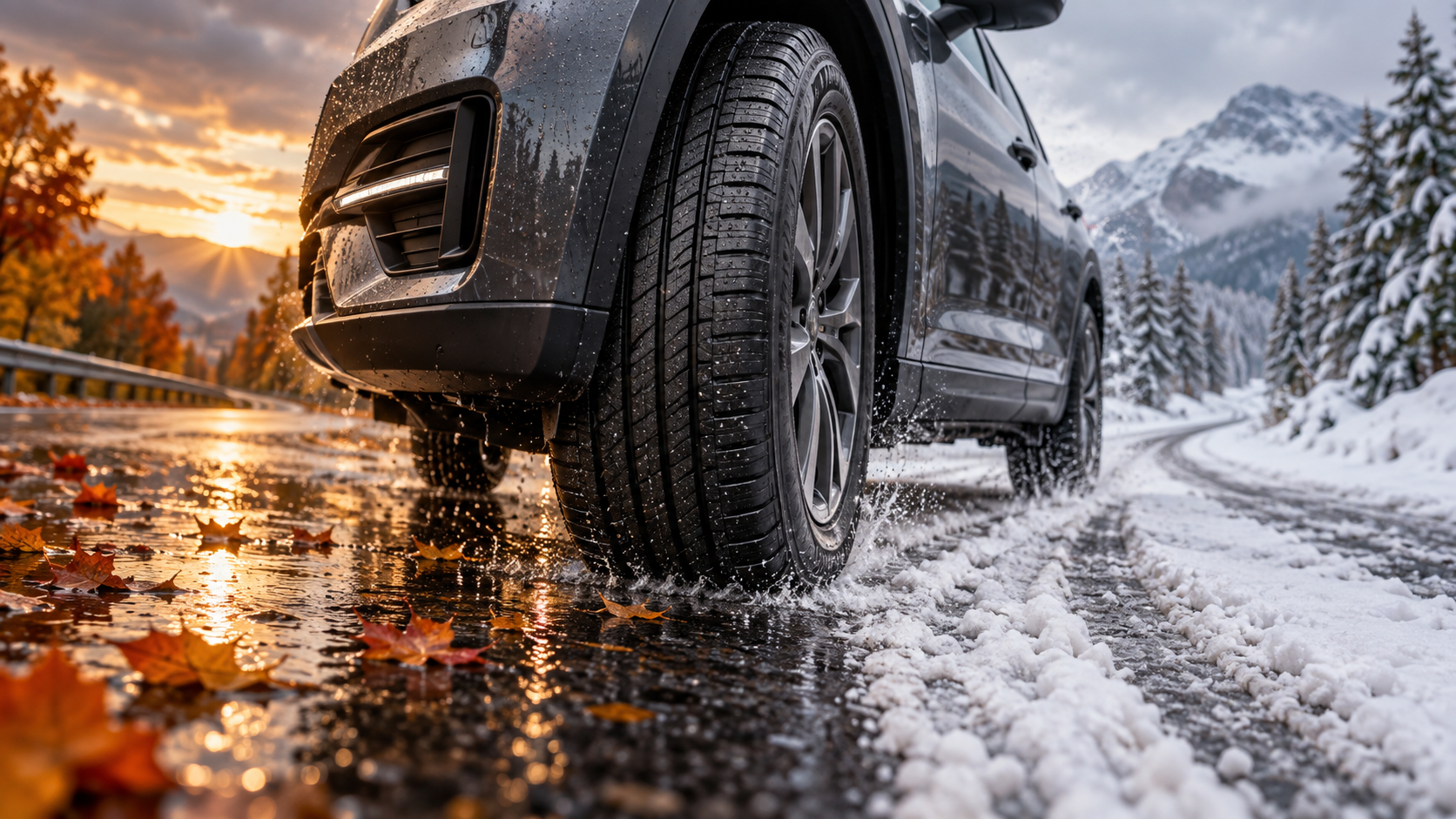
Buying tires sounds simple until you start reading the sidewalls and product descriptions. All-season. All-weather. Winter. Touring. Three-Peak Mountain Snowflake. M+S. Suddenly four pieces of rubber have turned into a research project.
And one question comes up again and again for drivers across the USA: what is the real difference between all season vs all weather tires?
The short version is fairly simple. Traditional all-season tires are designed around balanced year-round driving, with a strong focus on dry roads, rain, comfort, tread life, and some light-snow capability. Tires marketed as all-weather generally push the winter side of that equation further while still being designed for year-round use.
But there is a nuance worth knowing right away. Tire names aren’t always neat technical categories. Some tires marketed as all-season also qualify for the Three-Peak Mountain Snowflake, or 3PMSF, symbol. And some tires sold as all-weather may appear in a retailer’s broader all-season category.
So don’t shop by the marketing name alone. Look at the actual tire, its ratings, its sidewall markings, and the type of weather you really drive through.
The Quick Difference Between All-Season and All-Weather Tires
Think of a conventional all-season tire as the generalist. It wants to be comfortable in July, predictable during spring rain, reasonably quiet on the highway, and capable of handling occasional light snow.
An all-weather tire is usually the generalist who spent more time training for winter.
That extra cold-weather ability typically comes from tread compounds, tread patterns, sipes, and other design choices aimed at maintaining useful traction as temperatures fall and snow begins to cover the road.
- All-season tires usually prioritize dry and wet-road balance, ride comfort, tread life, and mild winter capability.
- All-weather tires generally provide stronger snow performance while remaining suitable for year-round driving.
- Many all-weather tires carry the 3PMSF symbol showing that they meet an established severe-snow traction requirement.
- A 3PMSF symbol does not automatically make a tire equivalent to a dedicated winter tire in every cold-weather condition.
- Some modern all-season tires also carry the 3PMSF symbol, so the words printed in the product category are only part of the story.
That last point is important. The 3PMSF mark indicates that a tire has passed a defined snow-traction performance threshold. It should not be interpreted as a universal guarantee of superior braking, cornering, or ice grip in every winter condition. :contentReference[oaicite:0]{index=0}
What Does “All-Season” Actually Mean?
The phrase sounds as though the tire should be equally good in January, April, July, and October. In practice, it means compromise.
A traditional all-season tire is engineered to cover a broad temperature range. Its tread compound needs enough flexibility for cooler weather without becoming excessively soft during a hot August highway trip.
The tread pattern also has several jobs. It needs channels for rainwater, stable tread blocks for dry handling, and enough biting edges to offer some traction when light snow arrives.
For drivers in places with relatively mild winters, that combination can make plenty of sense.
Think Atlanta, much of coastal California, central Texas, or areas where snow is an occasional event rather than a normal part of winter driving. A good all-season tire may cover the vast majority of conditions those drivers encounter.
But “all-season” does not mean “ideal for every season.”
Once temperatures stay low, snow accumulates regularly, or icy roads become part of daily life, the compromises become easier to notice.
What Makes an All-Weather Tire Different?
All-weather tires are designed to stretch the one-set-of-tires idea further into winter.
They usually feature more aggressive siping and tread designs intended to create additional biting edges in snow. Their rubber compounds are also selected with cold-weather flexibility in mind.
Many popular all-weather models qualify for the 3PMSF symbol. Current examples from major manufacturers include products such as Bridgestone WeatherPeak and Pirelli Scorpion WeatherActive, which are positioned as year-round tires while meeting severe-snow-service requirements. :contentReference[oaicite:1]{index=1}
That does not mean they are winter tires with a summer mode.
There is still a compromise.
A tire that gives you more snow traction may give up a little steering sharpness, dry-road precision, noise refinement, or warm-weather tread behavior compared with another tire designed mainly around mild-weather driving.
The size of those differences varies enormously from one tire model to another.
All-Season vs All-Weather Tires at a Glance
| Feature | Traditional All-Season | All-Weather |
|---|---|---|
| Dry-road performance | Usually very good for everyday driving | Usually very good, though design may favor winter capability more |
| Wet-road performance | Good to excellent depending on model | Good to excellent depending on model |
| Light snow | Usually acceptable on quality models | Generally stronger |
| Moderate winter conditions | More limited | Generally better suited |
| Ice | Limited | Improved on some models, but not equal to every winter tire |
| 3PMSF symbol | Some have it, many do not | Common |
| Year-round use | Yes | Yes |
| Warm-weather focus | Usually stronger | More balanced toward winter |
| Dedicated winter replacement | No | Not necessarily |
The 3PMSF Symbol Matters More Than the Name
Look at the sidewall of a winter-capable tire and you may see a small mountain containing a snowflake. That’s the Three-Peak Mountain Snowflake symbol.
It matters because it is tied to a performance requirement rather than simply a marketing phrase.
By comparison, the familiar M+S, M/S, or Mud and Snow marking is largely based on tread-pattern characteristics. It does not provide the same snow-traction performance certification represented by the 3PMSF mark. :contentReference[oaicite:2]{index=2}
Still, there is a common misunderstanding here.
People see the snowflake and assume the tire must perform like a premium dedicated winter tire on deep snow, packed snow, slush, and ice.
Not necessarily.
The 3PMSF requirement focuses on a defined level of snow acceleration traction. It does not mean every tire bearing the symbol will have identical braking, cornering, wet-road, or ice performance.
Two 3PMSF tires can behave quite differently.
That’s why the symbol is useful, but it should not be the only thing you compare.
Snow Performance: This Is Where the Difference Shows
Imagine two drivers leaving home after four inches of overnight snow.
One has a conventional touring all-season tire. The other has a well-rated all-weather model.
Both cars may get moving. Both may technically be drivable. But the all-weather tire is generally designed with more snow-oriented tread features.
You may notice the difference during acceleration, climbing a snowy hill, or pulling away from a stop.
And snow traction isn’t only about whether the wheels spin.
Stopping matters more.
Turning matters too.
A tire that gets you confidently away from the driveway but struggles when you need to brake is not giving you the whole winter package.
This is another reason not to judge tires solely by one certification symbol or one advertising claim.
What About Ice?
Ice is the tougher test.
All-weather tires can offer better cold-weather behavior than many conventional all-season tires, but ice remains a surface where dedicated winter tires often have a major advantage.
Winter tires are designed much more specifically for cold conditions. Their compounds, siping, tread-block behavior, and sometimes specialized materials are selected around winter traction rather than year-round compromise.
If freezing rain, polished intersections, steep icy streets, or long periods below freezing are normal where you live, all-weather tires may still leave you wanting more.
For occasional snow? Different story.
That’s exactly where the all-weather category becomes interesting.
Rain Performance Isn’t Automatically Better on One Type
It is tempting to assume “all-weather” must mean better in rain because, well, weather includes rain.
That’s not how it works.
Wet braking and hydroplaning resistance depend heavily on the specific tire design.
A premium all-season tire can outperform a mediocre all-weather tire in rain. Likewise, a well-engineered all-weather tire may offer excellent wet traction.
Look at actual model performance rather than the category name.
Tread depth matters too. Even a tire that was excellent in rain when new will lose some ability to manage standing water as the tread wears down.
Do All-Weather Tires Wear Faster?
Sometimes, but this is not a rule.
Cold-weather-friendly tread compounds and aggressive siping can create tradeoffs, but modern tire engineering has narrowed the gap considerably.
Some all-weather tires come with substantial treadwear warranties and are designed specifically for drivers who want to run one tire year-round.
Your actual tread life will depend on more than the words all-season or all-weather.
Alignment matters. Tire pressure matters. Vehicle weight matters. EV torque can matter. Rotation intervals matter. Driving style definitely matters.
A crossover driven gently on suburban roads may get a very different life from the same tire mounted on a heavy EV that spends its days launching hard from traffic lights.
Which Tire Is Quieter?
Historically, winter-focused tread patterns could get noisy.
Lots of grooves, blocks, and biting edges tend to create more opportunities for road noise.
Modern all-weather tires have improved considerably, though.
Many are designed as touring tires and place a lot of emphasis on ride quality and cabin comfort.
Still, if silence is your number-one priority and you rarely see snow, a comfort-oriented all-season model may make more sense than buying extra winter capability you barely need.
What About Fuel Economy?
Rolling resistance varies more by individual tire than by category.
A tire’s rubber compound, tread design, construction, inflation pressure, size, and vehicle application all influence how much energy it takes to roll down the road.
So don’t assume an all-weather tire will always hurt fuel economy.
But if maximizing range in an EV or squeezing every possible mpg from a hybrid matters to you, compare the exact models you’re considering.
A few percentage points can feel more noticeable when you’re watching an EV’s range estimate during a cold winter trip.
When All-Weather Tires Make a Lot of Sense
The sweet spot is a driver who experiences real seasons but does not regularly face severe winter conditions.
- You get several snowfalls each winter, but roads are usually plowed fairly quickly.
- You want stronger winter traction without storing a second set of wheels and tires.
- You commute through changing conditions and occasionally drive before plows arrive.
- You live in an area with cold winters but not months of deep snow and persistent ice.
- You travel into hillier or snowier areas often enough that ordinary all-season tires feel like a compromise.
- You want one year-round set but would prefer a tire carrying the 3PMSF symbol.
For those drivers, all-weather tires can be a very practical middle ground.
That’s essentially how several current all-weather products are positioned: year-round tires designed for four-season climates that see meaningful snow but not conditions severe enough to make dedicated winter tires the obvious solution. :contentReference[oaicite:3]{index=3}
When Traditional All-Season Tires Still Make Sense
If winter where you live means rain, cool mornings, and maybe one dusting of snow every couple of years, buying a more winter-oriented tire may not offer much practical benefit.
A quality all-season tire can provide excellent wet traction, comfortable highway behavior, long tread life, and predictable handling.
Drivers in warm regions may also prefer tires optimized around those conditions rather than carrying winter capability they rarely use.
Again, there is no prize for buying the most winter-capable tire if your car never sees winter.
When You Should Still Consider Dedicated Winter Tires
This is where the conversation gets important.
All-weather tires fill the gap between traditional all-season tires and dedicated winter tires. They do not erase that gap entirely.
Tire Rack specifically notes that non-winter tires carrying the 3PMSF symbol can improve snow traction over conventional all-season tires while still not matching true winter-tire capability across all adverse winter conditions. :contentReference[oaicite:4]{index=4}
If you regularly drive through heavy snow, hard-packed snow, freezing rain, icy mountain roads, or long stretches of subfreezing weather, dedicated winter tires deserve serious consideration.
That is especially true when you cannot simply wait for roads to improve.
Nurses, airport workers, emergency personnel, shift workers, and anyone else who must drive before the plows arrive have different needs from somebody working from home who can wait until noon.
What About AWD and 4WD?
This is a classic trap.
All-wheel drive can help your vehicle accelerate on slippery surfaces because power is available at more than one axle.
But AWD does not magically improve tire grip.
When you brake, your tires still determine how much grip exists between the vehicle and the road.
The same goes for turning.
A front-wheel-drive car on strong winter tires can sometimes feel far more controlled under braking than an AWD vehicle wearing unsuitable tires.
The drivetrain helps you move. The tires are the pieces actually touching the pavement.
Which Tire Type Fits Different US Driving Conditions?
| Typical Driving Situation | Traditional All-Season | All-Weather | Dedicated Winter |
|---|---|---|---|
| Warm climate, almost no snow | Very practical | Usually unnecessary | Not needed |
| Mild winter with occasional flurries | Often sufficient | Useful extra margin | Usually unnecessary |
| Four seasons with several snowfalls | Possible, depending on conditions | Very practical one-set option | Worth considering |
| Regular snow and freezing weather | Limited | Better compromise | Often the stronger winter option |
| Heavy snow, mountain travel, frequent ice | Poor match | May not be enough | Usually the most winter-focused choice |
| Driver can avoid roads during storms | More workable | Very flexible | Depends on winter severity |
| Driver must travel regardless of conditions | Less appealing in snowy regions | Useful | Often worth the seasonal swap |
Don’t Forget Your Actual Route
Climate maps only tell part of the story.
You might live in a city that gets relatively little snow but commute through a higher elevation every day.
You might live in Denver but mostly drive on major roads that are treated quickly.
Or you might live outside town on a shaded rural road where packed snow hangs around for days.
Same weather forecast. Completely different tire needs.
Your schedule matters too.
Road crews may have everything clear by 9 a.m. That doesn’t help much if your shift starts at 5:30.
How Temperature Changes the Equation
Tires aren’t affected only by snow.
Rubber behavior changes with temperature.
A tire designed around summer heat behaves differently as temperatures fall. Winter-oriented compounds are designed to remain useful in colder conditions, while year-round compounds have to balance cold-weather flexibility against warm-weather wear and stability.
This is why a dry-looking road in January is not automatically the same environment as that exact road in July.
Temperature is part of tire performance even when the sky is perfectly clear.
Can You Use All-Weather Tires in Summer?
Yes. That’s one of their main advantages.
Unlike dedicated winter tires, all-weather models are designed to remain on the vehicle during warm months.
You do not have to schedule spring and fall tire swaps.
You also avoid storing another set of tires or wheels.
For apartment dwellers or anyone without a garage, that alone can be a surprisingly big deal.
A second tire set takes up more space than you think until four dirty tires are sitting in the corner of your storage room.
Why Not Run Winter Tires All Year?
Because dedicated winter tires are designed around winter.
Running them through summer heat can increase tread wear and reduce the dry-road characteristics you would get from a tire designed for warmer conditions.
If you want one set for all twelve months, that’s where all-weather tires become much more sensible.
Cost: One Set or Two?
A traditional all-season setup may have the lowest immediate cost if you live somewhere mild and never need another tire set.
In a snowy climate, however, comparing prices gets more interesting.
All-weather tires may allow you to buy one set rather than maintaining separate warm-season and winter sets.
That means no second set of wheels, no twice-yearly changeover fees, and no tire storage.
But there is another side.
When you own two sets, each set covers only part of the year’s mileage. The tires may therefore last more calendar years before their tread is worn out, although age still matters regardless of tread depth.
So don’t compare only the checkout price.
Compare the entire ownership pattern.
How Tire Size Changes Your Options
Not every tire model comes in every size.
This matters especially on cars with large wheels, performance packages, unusual staggered setups, or certain EV fitments.
You may read about a fantastic all-weather tire and discover that it simply isn’t offered in the dimensions your vehicle requires.
Load rating and speed rating matter too.
Do not replace a tire based only on diameter and width. Make sure the replacement meets the vehicle manufacturer’s required specifications.
EV Drivers Have Another Factor to Think About
Electric vehicles put an interesting spin on tire shopping.
They’re often heavy because of their battery packs, and electric motors can deliver strong torque immediately.
That combination can accelerate tread wear.
Cabin noise also becomes more noticeable because there is no combustion engine masking road noise much of the time.
If you’re shopping for an EV, consider winter traction alongside load rating, rolling resistance, tread life, and noise.
One feature does not tell the whole story.
Read the Sidewall, Not Just the Advertisement
A product page may use words such as four-season, weather-ready, year-round, snow-ready, or all-weather.
The sidewall gives you information that is harder to dress up with marketing.
Look for the correct size, load index, speed rating, and relevant markings such as 3PMSF.
And if snow capability is important, verify whether the exact tire and exact size you are buying carries the certification. Do not assume every product from the same family is identical.
What to Check Before Buying
You do not need to turn tire shopping into a weekend-long engineering project. A little homework is enough.
- Confirm the exact tire size listed for your vehicle.
- Check the required load and speed ratings.
- Look for the 3PMSF symbol if meaningful snow performance is important.
- Compare wet braking and snow performance, not simply the product category.
- Consider road noise if you spend hours on the highway.
- Check treadwear warranty terms, but don’t treat the warranty as a prediction of exact mileage.
- Think about how often you actually drive in snow rather than how often snow appears in your regional forecast.
- Factor in tire storage and seasonal changeover costs if dedicated winter tires are the alternative.
Does Tread Depth Change Winter Performance?
Absolutely.
A tire does not perform forever like it did when brand new.
As tread wears down, the grooves have less volume available for water and slush. Snow traction can change too.
That means an all-weather tire with very little tread remaining should not be treated as though the 3PMSF logo gives it magical winter powers.
The certification belongs to the tire design. Your actual tire’s condition still matters.
Age matters as well. Rubber changes over time, which is why tire condition involves more than reading the odometer.
Can You Mix All-Season and All-Weather Tires?
Mixing tire types can create differences in grip and handling between the front and rear axles.
For predictable behavior, matching tires on all four corners is generally the cleaner setup.
That becomes especially important on AWD vehicles where manufacturers may place limits on differences in tire circumference or tread depth.
If one tire becomes damaged and the remaining tires are partly worn, check the vehicle manufacturer’s requirements before simply replacing one tire.
What If You Rarely Drive in Snow?
This is where people sometimes overbuy.
Imagine you live somewhere that sees snow three days a year, and you can simply work from home on those days.
Do you need an aggressive all-weather setup?
Maybe not.
A highly rated conventional all-season tire might better match the other 362 days.
Now change the scenario. You have a 40-mile commute, snow arrives ten times per winter, and your employer expects you at work regardless.
Suddenly that extra winter capability looks much more useful.
Your lifestyle is part of the tire specification.
FAQ
Are all-weather tires better than all-season tires?
Not in every situation. All-weather tires generally place more emphasis on snow and cold-weather traction, while a conventional all-season tire may put more emphasis on warm-weather refinement, handling, tread life, or efficiency. The better match depends on where and how you drive.
Can all-weather tires replace winter tires?
They can be a practical alternative for moderate winter conditions, especially for drivers who want one tire set all year. In areas with frequent ice, deep snow, mountain driving, or prolonged severe cold, dedicated winter tires can still provide more winter-focused performance.
Do all-weather tires have the snowflake symbol?
Many do. The Three-Peak Mountain Snowflake symbol is common on tires marketed as all-weather because it indicates the tire meets an established severe-snow traction requirement. Check the exact tire before buying rather than relying only on the category name.
Can an all-season tire have the 3PMSF symbol?
Yes. Some tires sold or categorized as all-season also meet severe-snow-service requirements and carry the 3PMSF symbol. That’s one reason the sidewall marking can tell you more than the marketing label alone. :contentReference[oaicite:5]{index=5}
Are all-weather tires good in summer?
Yes. They are designed for year-round use. Unlike dedicated winter tires, they can remain on the vehicle during warm weather. Individual models still differ in dry handling, noise, wear, and efficiency.
Are all-weather tires louder than all-season tires?
They can be, but it depends heavily on the model. Modern touring all-weather tires can be quite refined. More aggressive tread patterns may produce additional road noise compared with comfort-focused all-season tires.
Do I need all-weather tires if I have AWD?
AWD does not remove the need for appropriate tires. It can help with acceleration, but braking and cornering still depend heavily on tire grip. In snowy climates, tire choice remains important even with an AWD vehicle.
Conclusion
The debate over all season vs all weather tires sounds more complicated than it really is once you focus on your driving conditions.
Traditional all-season tires remain a practical choice for millions of US drivers. They work especially well where winters are mild, snow is rare, and most driving happens on dry or wet pavement.
All-weather tires shift that balance toward colder and snowier conditions.
They make particular sense for drivers who experience genuine four-season weather and want stronger winter capability without owning two complete tire sets.
The Three-Peak Mountain Snowflake symbol is useful here. It tells you the tire has met a defined severe-snow traction threshold rather than simply carrying an appealing winter-themed product name. But the symbol is not a promise that the tire behaves exactly like a dedicated winter tire in every snow and ice situation. :contentReference[oaicite:6]{index=6}
And that brings us to perhaps the most useful rule of the whole comparison: don’t buy the category. Buy the tire.
A premium all-season tire and a budget all-season tire can behave very differently. The same applies to all-weather tires.
Look at the actual model.
Check wet braking, snow traction, tread life, road noise, load rating, and the certifications that matter to you.
Then think about your real winter.
Not the worst storm you’ve seen on television. Not the snowiest day your city had twelve years ago. Your normal commute, your normal roads, and the times you actually need to drive.
If winter mostly means rain and a jacket, a conventional all-season tire may be exactly what you need.
If winter means repeated snowfalls, cold mornings, and occasional unplowed streets, an all-weather tire starts to look much more attractive.
And if your winter includes regular deep snow, mountain passes, persistent ice, and days when staying home simply isn’t an option, dedicated winter tires still deserve a place in the conversation.
There isn’t one tire that dominates every condition.
That’s the compromise built into tire engineering.
The useful question isn’t “Which category is better?”
It’s “Which compromise fits the roads I actually drive?”
Leave a Reply