
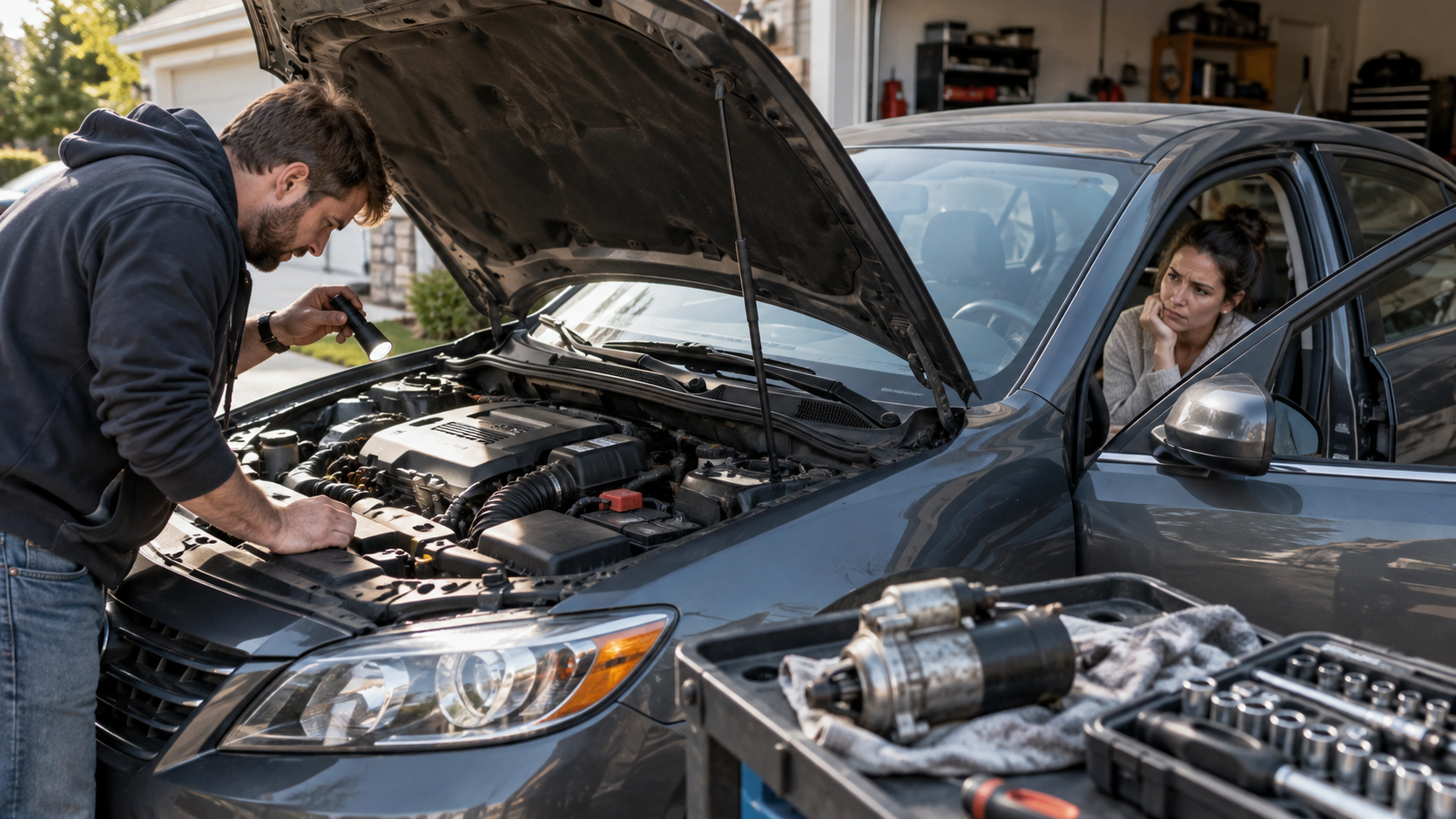
You turn the key or press the start button, and instead of the engine coming to life, you get a click. Maybe several clicks. Maybe silence. The lights still work, the radio comes on, and now you are sitting in a parking lot wondering whether the starter has finally given up.
If you are searching for how to start a car with a bad starter, there are a few things you can try before calling a tow truck. But there is an important catch: a car that will not crank is not automatically suffering from a bad starter.
A weak battery, corroded battery terminals, a bad ground connection, a failing starter relay, a transmission-range switch, or even a security-system issue can create very similar symptoms.
So the first goal is not to crawl under the car and start hitting things. It is to figure out what the car is actually telling you.
Some temporary methods can get a vehicle running one more time. Others are old-school tricks that can create sparks, damage wiring, or cause the vehicle to move unexpectedly. Those are not worth the gamble.
Here is the safer way to approach it.
What a Starter Actually Does
The starter is an electric motor that turns the engine fast enough for combustion to begin.
When you turn the key or press the start button, the vehicle sends an electrical signal to the starter circuit. A starter solenoid engages, the starter gear moves into contact with the engine’s flywheel or flexplate, and the starter motor spins the engine.
Once the engine starts running on its own, the starter disengages.
That whole process normally takes only a second or two, which is why the starter is easy to forget until it stops cooperating.
A starter motor draws a large amount of electrical current. That means the battery, terminals, cables, grounds, relay, solenoid, and starter itself all have to work together.
A fault anywhere in that chain may look like “the starter is bad.”
What Does a Bad Starter Sound Like?
There is no single sound that proves the starter has failed, but certain patterns are useful clues.
| What You Hear or Notice | Possible Cause | What It Tells You |
|---|---|---|
| One solid click | Starter solenoid, starter motor, weak connection, low battery | Starter circuit is attempting to engage |
| Rapid repeated clicks | Weak battery or poor electrical connection | Voltage is dropping when the starter tries to operate |
| Nothing at all | Battery, relay, ignition switch, neutral-safety switch, security system, starter circuit | Signal may not be reaching the starter |
| Grinding noise | Starter drive or flywheel/flexplate teeth | Stop repeated attempts and have it inspected |
| Starter spins but engine does not turn | Starter drive may not be engaging | Starter can spin without cranking the engine |
| Engine cranks normally but does not start | Usually not a starter problem | Look toward fuel, ignition, sensors, security, or another engine issue |
That last line is important.
If you hear the engine turning over at its normal speed but it simply refuses to start, the starter is doing its job. You are dealing with a different problem.
First Check the Battery
This sounds almost too obvious, but battery trouble is one of the easiest problems to mistake for starter failure.
A battery can have enough power to illuminate the dashboard while still being too weak to crank the engine.
The starter requires far more current than the radio, cabin lights, or instrument cluster.
Watch what happens when you attempt to start the vehicle.
If the dashboard lights become extremely dim, the headlights almost disappear, or you hear rapid clicking, the battery or battery connections deserve attention before the starter does.
Check the battery terminals visually. Heavy white, green, or blue corrosion can interfere with current flow. Loose terminal clamps can do the same thing.
If the battery is discharged, a proper jump-start may get the vehicle running. Follow the owner’s manual because jump-start procedures can vary, especially on hybrids, vehicles with batteries in unusual locations, and cars with dedicated jump terminals.
If a jump-start makes no difference and you still get one strong click, starter trouble becomes more plausible.
Try Starting the Car in Neutral
If your automatic-transmission vehicle will not start in Park, try Neutral.
Keep your foot firmly on the brake, apply the parking brake, move the shifter to Neutral, and try starting the engine normally.
If the engine suddenly cranks in Neutral but not in Park, the problem may involve the transmission-range switch or neutral-safety circuit rather than the starter itself.
Do not treat this as a permanent solution.
The car needs diagnosis, but at least you have learned something useful without taking anything apart.
Check the Battery Connections and Grounds
The starter depends on a very low-resistance electrical path.
A loose or corroded battery cable can interrupt that path. So can a poor engine ground strap.
Before assuming the starter motor is dead, look for:
- Loose battery terminal clamps.
- Heavy corrosion around battery posts.
- Damaged positive battery cables.
- Loose or damaged engine ground straps.
- Frayed cable ends.
- Signs of overheating around electrical connections.
Do not work on battery connections with metal jewelry on your hands or wrists. A ring or bracelet that accidentally bridges a high-current circuit can become dangerously hot in seconds.
If you are not comfortable working around a battery, skip this step and have the car checked.
Will Jump-Starting Help a Bad Starter?
Sometimes, but not because the jump-start repairs the starter.
A starter that is worn internally may still work when supplied with slightly higher available voltage. More often, however, a successful jump-start reveals that the battery was the real problem.
If your car starts immediately with jumper cables or a jump pack, do not automatically buy a starter.
Have the battery and charging system tested first.
If a fully charged, healthy battery produces the same single heavy click every time, then attention can shift toward the starter circuit.
The Old “Tap the Starter” Trick
You may have heard someone say, “Just tap the starter with a hammer.”
There is a reason this trick exists.
Inside some starter motors are brushes and electrical contacts that wear over time. Occasionally, a worn starter stops with the internal components sitting in a bad position. A light tap on the starter housing can sometimes shift them enough to make contact one more time.
But this is temporary at best.
And there are safety issues.
The starter may be difficult to reach. On some cars it sits near the exhaust, underneath the engine, or behind shields. Crawling under a car without proper support is dangerous. Touching hot exhaust components is another obvious risk.
If the starter is easily reachable from above with the engine off and the vehicle securely parked, a light tap on the starter body may occasionally help. Do not hammer on electrical terminals, the solenoid wiring, or plastic components.
Do not crawl underneath a vehicle that is supported only by its emergency jack.
If tapping the starter suddenly makes the car start, that is not good news for the starter. It is usually a strong hint that replacement or repair is near.
Can You Push-Start a Car With a Bad Starter?
A manual-transmission car may sometimes be started without the starter motor by using the vehicle’s motion to turn the engine.
This is often called push-starting, bump-starting, or roll-starting.
It is not suitable for normal automatic-transmission vehicles.
It also requires that the battery still has enough power for the vehicle’s ignition, fuel-injection system, engine computer, and fuel pump.
A completely dead electrical system will usually prevent a modern fuel-injected car from starting this way.
How Push-Starting a Manual Car Works
If the owner’s manual does not prohibit the procedure, the location is safe, traffic is absent, and you understand the risks, a manual car can sometimes be started like this:
- Turn the ignition on or place the vehicle in its normal run mode.
- Press the clutch pedal fully.
- Select second gear in many cars, rather than first, for a smoother engagement.
- Allow the vehicle to roll to a modest speed on a safe, controlled surface.
- Release the clutch fairly quickly while applying a small amount of throttle.
- Once the engine starts, press the clutch again to prevent the car from lurching.
This requires space and control. Do not attempt it in traffic, on a steep uncontrolled hill, near pedestrians, or anywhere the vehicle could roll into another car or object.
Some modern vehicles may have manufacturer-specific restrictions, so checking the owner’s manual is smart.
Why You Should Not “Jump” the Starter Terminals
You will find videos online showing someone bridging starter terminals with a screwdriver or another metal tool.
That is not a good general-purpose roadside trick.
The starter circuit carries very high current. Bridging terminals can create a large electrical arc, burn the person holding the tool, damage wiring, ignite flammable vapors, or cause the starter to engage unexpectedly.
There is also a bigger problem: bypassing normal controls can allow the starter to operate when the vehicle is not safely in Park or Neutral.
A car that suddenly moves while someone is leaning over or underneath it is a serious hazard.
If diagnosis requires electrically commanding the starter directly, that is better handled by a trained technician with the vehicle properly secured and the correct test equipment.
Can a Bad Starter Work Sometimes?
Yes. Intermittent starter failure is common.
A starter may work perfectly in the morning, refuse to operate after a trip, and then start again twenty minutes later.
That inconsistency can make the problem frustrating.
Heat can influence worn electrical contacts, solenoids, windings, and connections. Some failing starters behave worse when the engine compartment is hot.
You may notice a pattern where the car starts cold but only clicks after stopping for fuel or groceries.
Once it cools down, it starts again.
That pattern deserves diagnosis because intermittent failures rarely become more convenient with time.
Bad Starter vs. Bad Battery
| Symptom | More Typical of Battery Trouble | More Typical of Starter Trouble |
|---|---|---|
| Rapid clicking | Yes | Less commonly |
| Lights dim heavily when trying to start | Often | Possible if starter is drawing excessive current |
| One strong click with bright lights | Possible | Common clue |
| Jump-start fixes problem | Strong clue | Possible but less conclusive |
| Starter works after light tap | Unlikely | Strong clue |
| No dashboard power | Very possible | Starter alone would not normally cause this |
| Engine cranks slowly | Common | Possible |
Symptoms overlap, so testing is better than guessing.
A technician can perform a battery test, voltage-drop test, starter-current test, and circuit inspection to separate the possible causes.
What About the Starter Relay?
The starter relay is a smaller electrical switch that helps control the high-current starter circuit.
A failed relay may prevent the starter from receiving the signal to operate.
On some cars, the starter relay is located inside an under-hood fuse and relay box.
If the vehicle’s service information identifies another identical relay that serves a noncritical circuit, swapping relays can sometimes help with diagnosis. But layouts vary, and not every relay that looks the same has the same function or rating.
Do not randomly move relays around the fuse box.
Use the diagram and vehicle information.
Could the Ignition Switch Be the Problem?
Yes.
When you turn the key or press the start button, several systems participate before the starter actually receives power.
A failing ignition switch, start button circuit, brake-pedal switch, clutch switch, immobilizer, or transmission-range sensor can interrupt the start request.
This is especially worth considering if there is no click from the starter at all.
If the starter never receives a command, replacing the starter will not fix the car.
What if the Car Says “Key Not Detected”?
That points away from the starter.
Modern keyless-start vehicles depend on communication between the key fob and the car.
If the key-fob battery is weak, many vehicles have a backup method for starting. That may involve holding the key against the start button or placing it in a designated area inside the cabin.
The exact procedure varies, so check the owner’s manual.
A security or key-recognition problem can completely prevent starter operation even when the starter itself is healthy.
Does Turning the Key Repeatedly Help?
Sometimes an intermittent starter finally engages after several attempts.
But endless repeated cranking is not a great idea.
If the starter is stuck or drawing excessive current, repeated attempts can heat the motor, cables, battery connections, or solenoid.
If you are getting grinding noises, stop immediately.
A few controlled attempts may help identify an intermittent issue. Twenty or thirty angry key turns are unlikely to improve anything.
What if the Starter Keeps Running After the Engine Starts?
Turn the vehicle off as soon as it is safe to do so.
A starter that remains engaged with a running engine can be damaged very quickly. The starter drive, flywheel, wiring, relay, or solenoid may also be involved.
Do not keep driving and hope the noise disappears.
This is different from a starter that will not engage at all.
Can Cold Weather Make a Bad Starter Worse?
Yes, but cold weather also makes weak batteries much more noticeable.
Engine oil becomes more resistant to movement in low temperatures, while battery performance drops. The starter therefore has a harder job precisely when the battery can deliver less power.
A starter that seemed “fine enough” in August may suddenly become unreliable on a freezing January morning.
That does not automatically prove the starter is bad, though. In winter, battery testing becomes especially important.
Can Heat Cause Starter Problems?
Yes.
Starter motors are often mounted relatively close to the engine and exhaust system. High under-hood temperatures can make a worn starter more likely to fail intermittently.
A familiar pattern is this:
The car starts perfectly when cold. You drive for 30 minutes. You stop for ten minutes. Then you turn the key and get a click.
After the car sits and cools, it starts again.
This kind of hot-start problem can point toward the starter, solenoid, wiring resistance, battery cables, or related electrical connections.
When the Starter Clicks Once but Does Not Crank
A single click usually tells you that at least part of the start circuit is working.
The solenoid may be activating, but the motor may not be turning.
Possible reasons include a worn starter motor, damaged solenoid contacts, weak battery, bad battery cable, poor engine ground, or even a mechanically locked engine in rare cases.
This is where a voltage-drop test can be extremely useful.
A cable can look perfectly normal on the outside while having enough internal corrosion to prevent the starter from receiving the current it needs.
When the Starter Makes No Sound at All
Silence broadens the list of suspects.
The problem could be:
- A discharged or disconnected battery.
- A failed starter relay.
- A bad ignition switch or start-button circuit.
- A clutch switch on a manual-transmission vehicle.
- A Park/Neutral switch on an automatic vehicle.
- An immobilizer or key-recognition issue.
- A wiring fault.
- A failed starter solenoid.
- The starter motor itself.
Before replacing parts, confirm that power and the start command actually reach the starter circuit.
How Long Can You Drive With a Bad Starter?
Once the engine is already running, the starter normally does nothing.
So a bad starter usually does not cause the engine to shut off while you are driving.
The problem arrives after you turn the engine off.
You may not be able to start it again.
This leads some people to keep the car running while making stops. That can create its own safety issues, wastes fuel, and may be illegal or inappropriate in some locations.
If the starter is failing, the sensible plan is to drive directly to a repair facility while the vehicle is still running, if the car is otherwise safe to drive.
When Should You Stop Trying to Start the Car?
Repeated start attempts are not always harmless.
Stop and call for assistance if you notice smoke, a strong electrical-burning smell, melted wiring, severe grinding, unusually hot battery cables, or sparks.
Also stop if the battery terminals become hot enough to concern you.
Heat in a high-current connection usually means resistance, and that problem needs to be addressed before more attempts are made.
What a Mechanic Checks
A good diagnosis does not begin by throwing a starter at the car.
The shop may check battery state of charge, battery health, cable condition, voltage drop on the positive and ground circuits, starter current draw, relay function, start-command voltage, and the vehicle’s Park/Neutral or clutch-switch circuit.
On newer vehicles, a scan tool may also reveal security-system, transmission, body-control, or engine-control faults that prevent starting.
Only after the circuit is tested does the starter become the obvious replacement candidate.
How Much Does Starter Replacement Cost?
There is no useful single nationwide number because vehicle design matters enormously.
On some trucks, the starter is easy to reach and replacement is straightforward.
On other vehicles, surrounding parts may need to be removed before the starter can even be accessed.
Starter prices also vary widely between economy cars, trucks, luxury vehicles, and models with start-stop systems.
Ask for a quote that separates parts and labor.
If the shop recommends battery cables, a relay, or another component as well, ask what test confirmed the additional problem.
Should You Replace a Starter Yourself?
For an experienced DIY owner, starter replacement can be manageable on certain vehicles.
But starter wiring includes a direct high-current connection to the battery.
The battery must normally be disconnected before starter removal, and the vehicle may need to be raised safely.
That combination deserves respect.
A starter can also be heavier than expected, especially on trucks.
If access requires working underneath the vehicle, proper jack stands or a lift are essential.
An emergency tire jack alone is not safe support for someone working under a car.
What Is the Best Temporary Solution?
If the starter really is failing, there is no reliable temporary repair.
A jump-start may help if battery voltage is part of the problem. Starting in Neutral may work if the range switch is involved. A manual car may sometimes be bump-started. A lightly tapped starter may occasionally work one more time.
But these are clues and short-term workarounds, not repairs.
If one of them gets the engine running, the smart move is to head toward a place where the car can be diagnosed before shutting it off again.
FAQ
Can I start a car if the starter is completely dead?
With most automatic-transmission vehicles, not through normal means. A manual car may sometimes be push-started if the battery and engine-management systems still have power. Otherwise, repair or towing is usually required.
Will a jump-start work if the starter is bad?
It can occasionally help a weak or worn starter, but a successful jump-start more often points toward a weak battery or poor connection. If the starter is mechanically or electrically failed, extra battery power will not reliably solve it.
Can tapping the starter really make the car start?
Sometimes. Worn internal brushes or contacts may temporarily reconnect after a light tap on the starter housing. If this works, treat it as a warning that the starter likely needs replacement soon.
Can I push-start an automatic car?
Most modern automatic-transmission vehicles cannot be bump-started in the way a manual car can. Do not tow or roll an automatic vehicle for this purpose unless the manufacturer specifically says the procedure is permitted.
Why does my starter click but not turn the engine?
A single click can come from a weak battery, poor cable connection, damaged solenoid, worn starter motor, bad ground, or another high-current circuit problem. Testing voltage at the starter helps separate these causes.
How can I tell whether the battery or starter is bad?
Rapid clicking, very dim lights, and a car that starts easily with a jump often point toward the battery. One solid click with a fully charged battery can point more toward the starter. Proper electrical testing gives a more reliable answer.
Can a bad starter leave me stranded suddenly?
Yes. A starter can become intermittent before failing completely. If the vehicle sometimes needs several attempts, only starts when cold, or responds after the starter is tapped, arrange a repair before the problem becomes permanent.
Conclusion
Learning how to start a car with a bad starter is really about knowing which temporary tricks are reasonable and which ones create more risk than they are worth.
Start with the simple checks.
Look at the battery. Check whether the lights dim heavily. Try a proper jump-start if the battery may be weak. On an automatic vehicle, try starting in Neutral. Look for obvious corrosion or loose battery terminals.
If you drive a manual car, a controlled push-start may sometimes get you moving when the starter itself will not turn the engine.
And yes, an old starter may occasionally respond to a light tap on its housing. If it does, treat that as your chance to get the vehicle repaired, not as a new starting routine.
Avoid dramatic shortcuts.
Bridging starter terminals with a screwdriver, crawling under a vehicle supported only by a jack, or repeatedly forcing a grinding starter to operate can turn an inconvenient breakdown into a damaged car – or an injury.
Also remember that many “bad starter” problems are not starter problems at all.
A discharged battery can click. A corroded cable can click. A bad neutral-safety switch can create complete silence. A key-recognition issue can prevent cranking. A relay can fail. A poor engine ground can make a perfectly good starter look dead.
That is why testing matters.
If a temporary method gets the engine running, take advantage of it. Drive to a repair shop or another safe place where the starting system can be checked before switching the engine off again.
A starter is not supposed to require tricks every morning.
When it starts giving you warnings, fixing the real cause is far easier than discovering one day that the final click really was the final click.
Leave a Reply