
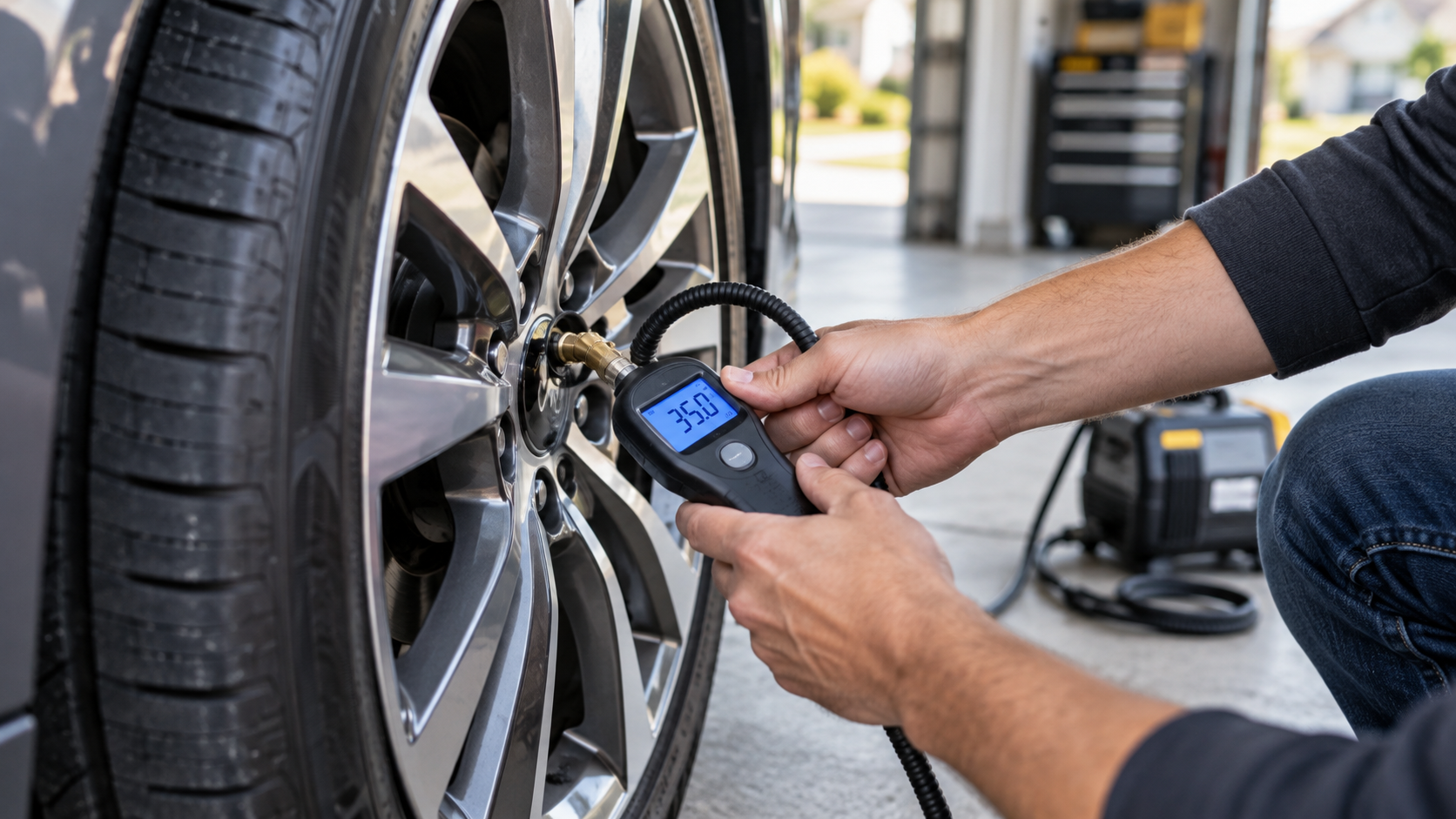
Tire pressure is one of those car-maintenance details that’s easy to ignore until a warning light appears on the dashboard. The tires look normal. The car still moves. Nothing seems urgent. So, naturally, checking the pressure gets pushed to next weekend.
But tire pressure affects more than whether a tire looks flat. It influences handling, braking, tread wear, ride comfort, fuel economy, and how much heat builds inside the tire while you’re driving.
The tricky part? There isn’t one universal recommended tire pressure for every vehicle.
Your neighbor’s SUV may call for 35 psi. Your sedan could require 32 psi. A pickup may have different values for the front and rear tires. Some vehicles even specify another pressure when heavily loaded.
And no, the large number printed on the tire sidewall usually isn’t the pressure you should automatically inflate to. That’s one of the most common mistakes drivers make.
Here’s how to find the right number, check it correctly, and make sense of pressure changes without turning a five-minute maintenance task into a science project.
Where to Find the Recommended Tire Pressure
For most vehicles sold in the USA, the first place to look is the tire information placard. It’s commonly located on the driver’s door jamb or inside the driver’s door area.
The placard usually shows the original tire size and the vehicle manufacturer’s recommended cold inflation pressure for the front and rear tires.
You can also find the information in the owner’s manual.
This matters because the vehicle manufacturer sets pressure recommendations based on the vehicle’s weight, handling characteristics, suspension, load capacity, and original tire specifications.
So if the sticker says 35 psi, that’s normally your starting point when the tires are cold.
- Check the driver’s door jamb for the tire placard.
- Look in the owner’s manual if the placard is damaged or hard to read.
- Pay attention to separate front and rear pressure values.
- Confirm that your current tire size matches the vehicle specifications.
- If the vehicle has replacement wheels or a non-standard tire setup, ask a qualified tire professional whether the factory pressure still applies.
That last point is easy to overlook. If a previous owner installed a very different tire size or load-rated tire, simply copying the factory sticker may not tell the whole story.
Why the Number on the Tire Sidewall Is Different
Walk up to a tire and you’ll find plenty of numbers. Somewhere on the sidewall, you’ll often see a maximum inflation pressure.
That number is not automatically your recommended tire pressure.
Think of it this way: the tire manufacturer tells you what the tire itself is rated to handle under defined conditions. The vehicle manufacturer tells you the pressure appropriate for that tire’s application on your vehicle.
Those are two different jobs.
Inflating every tire to the maximum number molded into the sidewall can result in pressure well above the vehicle’s intended setting. That can change ride quality, handling, and tread contact with the road.
For normal everyday driving, start with the vehicle placard rather than the tire’s maximum-pressure marking.
What Does PSI Mean?
PSI stands for pounds per square inch. In the United States, it’s the measurement you’ll most often see on vehicle placards, tire gauges, compressors, and dashboard tire-pressure displays.
You may also see pressure listed in kPa, or kilopascals, especially on digital equipment or vehicles designed for several international markets.
For reference, 1 psi is roughly 6.9 kPa.
You don’t really need to memorize the conversion. Just make sure the gauge and the placard are being read in the same unit.
| Pressure | Approximate kPa | Typical Context |
|---|---|---|
| 30 psi | 207 kPa | Seen on some passenger vehicles |
| 32 psi | 221 kPa | Common passenger-car range |
| 35 psi | 241 kPa | Common on many cars and crossovers |
| 36 psi | 248 kPa | Used by some sedans and SUVs |
| 40 psi | 276 kPa | Found on some vehicles and applications |
| 45 psi | 310 kPa | Possible on heavier-duty setups |
These numbers are examples, not universal recommendations. Your own vehicle placard is what matters.
Why Tire Pressure Should Be Checked Cold
This is one of the most important details.
Recommended pressure is generally given as cold tire pressure.
A tire heats up as you drive. The air inside warms, and pressure rises. That means a tire that starts at 35 psi may show a noticeably higher reading after highway driving.
That increase is normal.
So what counts as cold?
A practical approach is checking the tires before driving for the day or after the vehicle has been parked for several hours. If you’ve just finished a long highway trip, that’s not the ideal time to adjust them down to the placard number.
Why? Because you may release air that the tire actually needs once it cools again.
If a warm tire reads higher than the cold recommendation, don’t panic. Let the tires cool and check again.
How Much Does Temperature Affect Tire Pressure?
Quite a bit.
Air pressure falls as temperatures drop and rises as temperatures climb. A commonly used rule of thumb is roughly 1 psi of change for every 10°F change in ambient temperature, though real-world results aren’t perfectly identical in every situation.
This is why TPMS lights seem to appear everywhere on the first genuinely cold morning of fall.
Your tire didn’t necessarily develop a leak overnight. The temperature may simply have dropped enough to pull the pressure below the monitoring system’s threshold.
Still, don’t assume cold weather is always the only reason.
A tire can lose pressure because of a puncture, damaged valve stem, rim issue, or slow leak. If one tire repeatedly drops while the others stay stable, that’s worth checking.
Seasonal Tire Pressure Changes in the USA
The USA covers an enormous range of climates. A January morning in Minnesota has very little in common with January in South Florida.
Drivers in colder states often notice more dramatic seasonal pressure changes. Someone in Phoenix may notice increases during extreme summer heat, especially after the vehicle has been sitting in the sun or driven at highway speeds.
The key is not to chase the pressure every few hours.
Check and adjust it when the tires are cold, using the vehicle’s specified pressure as the target.
A seasonal habit works well:
- Check pressure when temperatures make a major seasonal shift.
- Recheck after the first serious cold spell of fall or winter.
- Check again when spring temperatures rise.
- Inspect all four tires rather than adjusting only the one that triggered a warning.
- Don’t forget the spare tire if your vehicle has an inflatable spare.
That spare is easy to ignore for three years and then desperately need on the side of an interstate. Not ideal.
How Often Should You Check Tire Pressure?
A monthly check is a sensible routine for most drivers, and checking before a long road trip is also smart.
You don’t need to obsess over it every morning.
But waiting until a tire visibly looks low is not a great system. Modern radial tires can be significantly underinflated before the difference becomes obvious just by looking at them.
That’s why a small digital gauge in the glove box can be more useful than a visual inspection.
How to Check Tire Pressure Correctly
You don’t need much equipment. A basic digital or dial tire-pressure gauge works fine, and many portable inflators now include built-in gauges.
Start with cold tires.
Remove the valve cap, press the gauge firmly onto the valve stem, and read the pressure. If you hear air escaping continuously, reposition the gauge until you get a clean seal.
Compare the reading with the driver’s door placard.
If the pressure is low, add air in small amounts and check again. If it’s too high while the tire is cold, release a little air and recheck.
Then replace the valve cap.
Simple. Usually less than ten minutes for all four tires.
What Happens When Tire Pressure Is Too Low?
Underinflation changes the way the tire contacts the road.
The sidewall flexes more, which can generate additional heat as the tire rotates. Steering may feel less precise. Rolling resistance can increase, and the tire may wear unevenly.
Severe underinflation is more serious.
A tire carrying vehicle weight with far less pressure than intended can overheat and suffer structural damage. At highway speed, that’s not something you want to discover the hard way.
Common clues can include:
- A TPMS warning light.
- Sluggish or heavy steering feel.
- A tire that appears lower than the others.
- Uneven wear toward the outer edges of the tread.
- A recurring pressure drop in one specific tire.
- Reduced fuel efficiency in some cases.
If one tire loses several psi repeatedly, adding air every week isn’t really fixing the problem. Find the leak.
What Happens When Tire Pressure Is Too High?
More isn’t automatically better.
Overinflation can make the ride feel firmer and may alter how the tread contacts the road. Depending on the tire and vehicle, handling can feel different, and uneven tread wear may develop.
The important distinction is between normal pressure rise from driving and deliberately setting cold pressure too high.
If your tire starts at the correct cold pressure and rises during driving, that’s expected.
Don’t stop halfway through a road trip and bleed air simply because the warm reading is higher than the placard number.
Recommended Tire Pressure vs Maximum Tire Pressure
| Item | Recommended Tire Pressure | Maximum Sidewall Pressure |
|---|---|---|
| Who determines it? | Vehicle manufacturer | Tire manufacturer |
| Where is it found? | Door placard or owner’s manual | Tire sidewall |
| Purpose | Normal vehicle operation | Tire’s maximum-rated inflation information |
| Should it be your everyday target? | Generally yes, when tires are cold | Usually no |
| Can front and rear values differ? | Yes | Sidewall rating is specific to the tire |
| Does driving increase the reading? | Yes, pressure normally rises with heat | The molded maximum does not change |
What Does the TPMS Warning Light Mean?
Since the late 2000s, new passenger vehicles sold in the United States have been required to include tire-pressure monitoring systems.
TPMS is helpful, but it isn’t meant to replace routine pressure checks.
The system is primarily a warning tool. By the time the warning appears, the pressure may already be meaningfully below the vehicle’s recommended level.
So if your placard says 35 psi, don’t assume the absence of a warning means all four tires are sitting perfectly at 35.
They might be 33. They might be 31. Depending on the system and conditions, the warning may not appear yet.
Use a gauge occasionally even when the dashboard looks happy.
Why the TPMS Light Often Appears on Cold Mornings
This is a familiar scene.
You park the car at night. Everything looks fine.
Overnight, temperatures fall sharply. You start the car at 7 a.m., and suddenly the tire symbol lights up.
The tires haven’t necessarily failed. Their pressure may simply have dropped with the temperature.
Check all four tires while they’re cold. Inflate them to the placard values if needed.
If the light returns soon after, especially on only one corner, investigate further.
Is 35 PSI Good for Every Car?
No.
Thirty-five psi is common enough that people sometimes treat it like a universal number. It isn’t.
Some vehicles specify around 30 to 32 psi. Others call for 36, 38, 40, or more. Heavy-duty trucks and certain high-load applications can require substantially higher pressures.
Front and rear numbers may differ too.
The right number for a Honda sedan isn’t automatically correct for a Ford pickup, Tesla, minivan, sports car, or three-row SUV.
Check the sticker.
Should Front and Rear Tires Have the Same Pressure?
Sometimes yes. Sometimes no.
Vehicle weight distribution and suspension design can lead manufacturers to specify different front and rear pressures.
A vehicle might call for 35 psi front and 38 psi rear, for example. Another might specify the same pressure on all four corners.
Don’t “correct” different factory values simply because matching numbers feel neater.
If the placard gives different values, there’s a reason.
What About SUVs and Pickup Trucks?
This is where pressure questions can get more interesting.
Some trucks and larger SUVs carry considerably more weight than ordinary passenger cars. Tire pressure may also change depending on load, towing, tire type, and vehicle configuration.
Heavy-duty pickups can have much higher pressure recommendations than compact crossovers.
Don’t copy a pressure number from another truck that looks similar.
Two pickups parked next to each other may have completely different tire sizes, axle ratings, load capacities, and recommended pressures.
Tire Pressure When Towing or Carrying Heavy Loads
Loading the vehicle heavily changes what the tires are being asked to do.
Some manufacturers provide separate tire-pressure guidance for high-load conditions. You’ll find this information in the owner’s manual, on supplemental labels, or in manufacturer documentation.
Do not automatically add 10 psi because you’re towing a trailer.
The vehicle’s instructions matter here.
You also need to respect tire load ratings, axle ratings, and the maximum allowed pressures for the tire and wheel assembly.
If you’re towing a large trailer and aren’t sure what pressure applies, this is one of those situations where getting guidance from a qualified tire or vehicle service professional is worth the few minutes it takes.
Does Highway Driving Require More Tire Pressure?
For most modern passenger vehicles, the normal cold pressure listed on the placard is intended to cover ordinary driving, including highway use.
You generally don’t need to add extra pressure every time you’re planning an interstate trip unless the vehicle manufacturer specifically says otherwise.
What you should do before a road trip is check the pressure cold.
A four-hour highway drive will heat the tires and raise the reading. That’s normal.
Should You Lower Tire Pressure in Rain?
No, not for ordinary road driving.
Lowering pressure below the manufacturer’s recommendation isn’t a smart way to create extra wet traction.
Proper tread depth, good tire condition, sensible speed, and correct cold inflation matter far more.
Underinflation can increase heat and hurt tire stability. That’s not a useful trade on a rainy interstate.
Should You Increase Pressure in Winter?
Usually, the goal remains the manufacturer’s recommended cold pressure.
The confusion comes from temperature.
Let’s say your tires were set correctly during a 70°F afternoon. A few weeks later, you’re checking them on a 25°F morning. The pressure may now be lower simply because the air temperature dropped.
You’ll need to add air to bring the cold reading back to the placard number.
That’s different from intentionally running above the recommendation just because it’s winter.
What Happens When You Drive From a Cold Climate to a Warm One?
Picture a winter road trip from Chicago to Florida.
You set the tires correctly on a freezing morning before leaving. Two days later, you’re standing next to the same car in 75°F sunshine.
The cold tire pressure may now be higher because the ambient temperature is much warmer.
If you’re spending significant time in the warmer climate, check the tires again when they’re cold and adjust according to the vehicle specification.
Seasonal travel is a great example of why pressure shouldn’t be treated as a one-time setting that lasts forever.
Does Altitude Affect Tire Pressure?
Altitude can influence gauge pressure because atmospheric pressure changes with elevation, though temperature usually creates the changes drivers notice most often in everyday use.
If you’re driving from sea level into high mountains, don’t obsess over every small change.
Check the tires cold, keep them near the vehicle’s specified pressure, and pay attention to large or unusual differences between tires.
Do Nitrogen-Filled Tires Need Different Pressure?
No.
If your vehicle specifies 35 psi, the target doesn’t suddenly become 38 psi because the tires contain nitrogen.
Nitrogen can reduce the rate of pressure change from gas permeation compared with ordinary compressed air, but tires still need monitoring.
And if a nitrogen-filled tire is low and only ordinary compressed air is available, topping it up with air is generally preferable to driving around underinflated.
Air itself is already mostly nitrogen anyway.
Does Tire Pressure Affect Fuel Economy?
Underinflated tires can increase rolling resistance, which means the vehicle must work harder to keep moving.
The difference from a slightly low tire may not feel dramatic on a single commute, but maintaining correct pressure is one of the simplest ways to avoid unnecessary rolling resistance.
On EVs, the effect can also show up as reduced driving range.
Still, don’t overinflate tires in an attempt to chase better mpg or extra EV range. The vehicle’s recommended pressure remains the sensible target.
Tire Pressure and Electric Vehicles
EVs deserve a quick mention because they’re often heavier than similarly sized gasoline vehicles due to the battery pack.
They can also produce strong torque instantly.
That combination makes proper tire maintenance especially useful. Tire pressure can affect efficiency, tread wear, ride comfort, and handling.
Many EVs display individual tire pressures on the center screen or instrument panel, which is handy.
But the same basic rule applies: use the manufacturer’s cold-pressure recommendation rather than guessing from another EV model.
Does Tire Pressure Affect Tread Wear?
Yes.
Consistent underinflation can contribute to wear patterns toward the shoulders of the tire, while excessive pressure may contribute to greater wear toward the center depending on the tire and operating conditions.
But pressure isn’t the only cause of strange tread wear.
Wheel alignment, worn suspension components, tire rotation habits, aggressive driving, and improper balancing can all play a role.
If one tire is wearing much differently from the others despite correct pressure, don’t keep blaming the air.
What If One Tire Is Always Low?
That’s a leak until proven otherwise.
Maybe it’s a tiny nail. Maybe the valve core is leaking. Maybe corrosion or damage around the wheel is affecting the seal. Sometimes the problem is small enough that the tire loses only a couple of psi over several days.
Repeatedly topping it up might keep the warning light off, but it doesn’t repair the cause.
If one tire consistently loses pressure faster than the others, have it inspected.
Can Tire Pressure Be Checked at a Gas Station?
Yes, but there are a couple of catches.
If you drove several miles to reach the station, the tires are no longer truly cold. The gauge built into a heavily used public air machine may also be less accurate than a decent personal gauge.
A small digital gauge costs little, fits in the glove box, and gives you a consistent tool every time.
If you frequently travel, a compact 12-volt or battery-powered inflator can be handy too.
What About the Spare Tire?
People forget this one constantly.
A compact temporary spare often requires much higher pressure than the vehicle’s road tires. Some temporary spares are specified around 60 psi, though you should always check the marking and vehicle instructions for your exact spare.
Since a spare may sit unused for years, it can gradually lose pressure.
Finding that out after you’ve already removed a flat tire is a pretty unpleasant surprise.
Check the spare periodically, particularly before long road trips.
FAQ
What is the recommended tire pressure for most cars?
There is no single pressure for most cars. Many passenger vehicles fall somewhere in the low-to-upper 30 psi range, but your vehicle may be different. Check the driver’s door placard for the correct cold inflation pressure.
Is 35 psi too high?
Not necessarily. Many vehicles specify around 35 psi. For another vehicle, 35 psi could be above or below the intended value. The door placard settles the question.
Should I inflate my tires to the number on the sidewall?
Usually no. The sidewall generally shows maximum tire-related information rather than your vehicle’s everyday recommended pressure. Use the vehicle placard for normal cold inflation.
Why does my tire pressure increase after driving?
Driving heats the tire and the air inside it, causing pressure to rise. This is normal. That’s why manufacturers specify pressure with the tires cold.
How often should I check my tire pressure?
About once a month is a practical routine for most drivers. Check again before long trips and after major seasonal temperature changes.
Why did my TPMS light come on when the weather got cold?
Cold air can reduce tire pressure enough to trigger the warning system. Check all tires cold and inflate them to the vehicle specification. If one tire keeps dropping, have it inspected for a leak.
Should front and rear tire pressures always match?
No. Some manufacturers specify different front and rear pressures because of vehicle weight distribution and engineering. Follow the numbers listed for each axle on the placard.
Conclusion
Finding the recommended tire pressure isn’t difficult, but a lot of bad habits make it seem more confusing than it needs to be.
The most important number normally isn’t on the tire itself. It’s on the vehicle’s tire placard, usually inside the driver’s door area.
Check pressure when the tires are cold. Use a reliable gauge. Adjust all four tires according to the vehicle manufacturer’s specifications, and remember that front and rear pressures may not always match.
Then keep temperature in mind.
A cold snap can drop tire pressure enough to trigger a warning light. Summer heat and highway driving can push the reading higher. Those changes don’t automatically mean something is wrong.
What deserves attention is a tire that consistently behaves differently from the others.
If the left rear loses three psi every week while the other tires barely change, don’t just keep feeding it air. Get it checked.
Also remember that TPMS is a warning system, not your personal tire technician. The absence of a warning light doesn’t guarantee that every tire is sitting exactly at the recommended pressure.
A monthly manual check still makes sense.
And if you’re towing, hauling a heavy load, running non-standard tires, or driving a heavy-duty truck, take an extra minute to read the vehicle’s specific pressure guidance. Those situations can require different considerations from an ordinary passenger car.
For most drivers, though, the routine is refreshingly simple: find the placard, check the tires cold, set them to the specified PSI, and recheck every few weeks.
Five or ten minutes can help preserve tire life, maintain predictable handling, and reduce the chance that a slow leak catches you on the worst possible morning.
Not glamorous car care. Still worth doing.
Leave a Reply